Your rooftop solar is installed. So, is your job over now?
Not really.
In fact, some of the most practical questions start only after you begin using the system.
Why is the electricity bill still coming?
Where did my generated solar units go?
Why does generation fall during monsoon?
Why does an on-grid solar system stop during a power cut even when the sun is shining?
And if you have a battery, how much can it actually run?
I have a 5 kW hybrid rooftop solar system installed at my own home and I also come from the energy industry.
So, many questions in this article are the same questions that came to my mind after actually living with solar, not only while reading about it.
I started checking them in detail. I went through government documents, CEA and MNRE material and also looked at real discussions among Indian rooftop solar owners.
Interestingly, many homeowners are also asking the same questions.
So, let us discuss 30 practical questions that usually start after the solar system is installed.
If you are still planning your rooftop solar system and confused about 2 kW, 3 kW or 5 kW?
First check the BharatGoGreen Home Solar Size Calculator.
This article starts after your solar system is already installed.
30 Rooftop Solar Problems After Installation in India
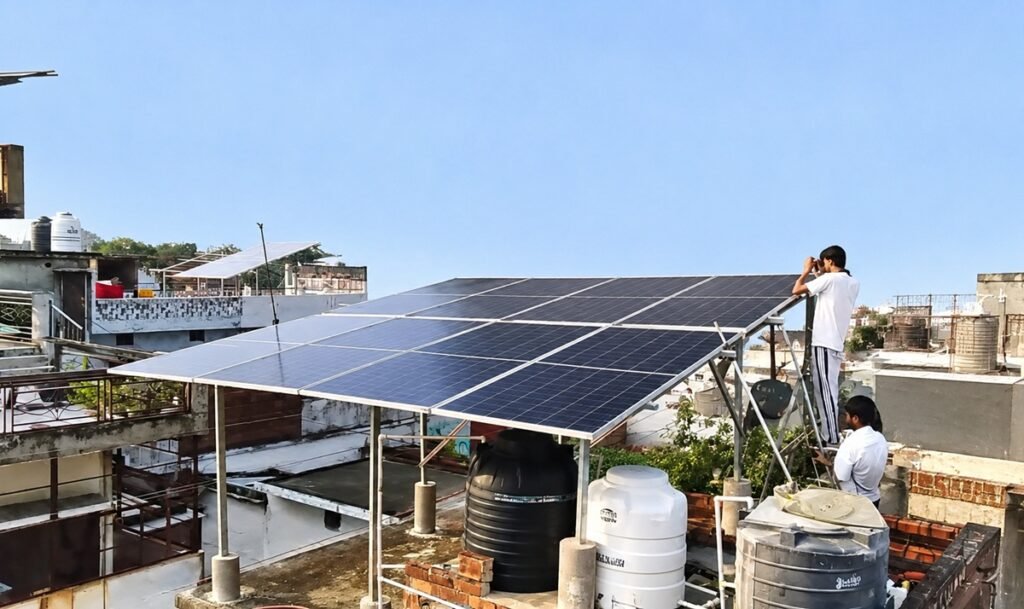
1. My Solar App Shows 500 Units but My Net Meter Shows Only 250 Exported. Where Did the Other Units Go?
Most likely, the missing units were used directly inside your house.
Suppose your solar is producing 3 kW at noon and your AC, refrigerator, fans and other appliances together are using 2 kW.
Around 2 kW is consumed directly by your house and only the balance goes to the grid.
So, for a simple grid connected system:
Solar generation ≈ Direct solar consumption + Solar export
A Lucknow homeowner recently reported about 521.9 units generated but only 254 units exported. The vendor explained that the balance was directly used inside the house.
Does this mean something is wrong with the solar system?
Not necessarily.
Your solar inverter or monitoring system measures solar generation. The bidirectional meter measures electricity imported from and exported to the grid.
So, solar generation and solar export are not the same thing.
The official rooftop solar FAQ also explains the same energy flow. Solar electricity is first available for self consumption and excess electricity is exported to the grid.
One more thing. Compare readings for exactly the same dates.
Your solar app may show generation from 1st to 31st August while your electricity bill may cover a different billing period.
2. How Can I Calculate My Home’s Actual Electricity Consumption After Rooftop Solar?
This is something many solar owners do not realize.
After installing rooftop solar, your electricity bill may no longer show how much electricity your house actually used.
Why?
Because some electricity is coming directly from your solar panels and never comes from the grid.
For a simple system, if generation, import and export are for the same period:
Home consumption ≈ Solar generation + Grid import − Solar export
Let us take an example.
Solar generation = 500 units
Grid import = 400 units
Solar export = 250 units
Approximate home consumption = 500 + 400 − 250 = 650 units
You may look at 400 imported units and think your house consumed only 400 units.
Actually, it consumed around 650 units. The remaining electricity came from your own solar system.
Now compare this with your electricity use before installing solar.
Suppose you were using around 450 units per month earlier but now the calculation shows 650 units.
Where did these extra 200 units come from?
Maybe another AC was added. Maybe AC running hours increased.
An EV may now be charging at home. Sometimes we also start using electricity more freely after installing solar because we feel that electricity is now free.
This simple calculation can help you understand what is actually happening.
However, battery charging and discharging, different meter arrangements and mismatched reading dates can change the calculation.
3. Why Is My Electricity Bill Still High After Installing Solar?
You installed rooftop solar mainly to reduce your electricity bill.
Then why is a big bill still coming?
First separate four numbers:
- Solar generation
- Grid import
- Solar export
- Actual home consumption
A high bill does not automatically mean that your solar panels are performing badly.
Your electricity consumption may have increased. Solar generation may have been lower during that month.
The billing period may not match the dates shown in your solar app. Import or export readings may also need to be checked.
And there is another important point.
A solar electricity bill does not necessarily become zero.
The official rooftop solar FAQ itself says that minimum charges such as fixed charges may remain even when electricity charges are substantially reduced.
The exact billing method can also differ from one state to another because net metering, net billing and settlement are governed through the applicable State Commission regulations.
This confusion is still quite common.
A Chennai homeowner with a 9.86 kW solar plant reported an unusually high import reading in August 2026 and approached the electricity authority.
A Goa homeowner with an 8 kW system reported more than 1,000 units of solar generation but was still trying to understand a bill of around ₹2,900.
So, where should you start?
Compare the physical meter readings with the readings printed on your electricity bill. Then compare import, export and solar generation for exactly the same period.
If the numbers themselves do not match, the problem may not be with your solar panels at all.
4. Why Am I Still Paying a Bill When I Export More Units Than I Import?
Because your electricity bill is not always simply imported units minus exported units.
Suppose you imported 200 units from the grid but exported 300 units from your solar system.
You may think, “I have given 100 units extra to the grid. Why should I pay anything?”
This is where many solar owners get confused.
Apart from electricity units, your bill may have fixed charges, service charges, electricity duty or other charges depending on your state, DISCOM and tariff category.
How surplus solar units are adjusted or carried forward can also differ from one state to another.
A 5 kW solar owner in Indore reported the same issue. Even when his system had surplus solar credits, fixed and service charges continued to appear on the electricity bill.
So do not look only at the final payable amount.
First see how many units you imported. Then check your exported units and how they were adjusted. After that, look at the remaining charges separately.
This is also why your neighbour in another state may give you a completely different answer. Both of you may have the same 5 kW solar plant, but the billing rules may not be the same.
For the exact calculation, check the latest net metering and tariff rules of your own State Electricity Regulatory Commission and DISCOM.
5. Solar Is Installed but My Net Meter Is Not Ready. Can I Switch It On?
Your panels are on the roof. The inverter is also installed.
So can you simply switch on the system and start exporting electricity?
Not necessarily.
Physical installation of rooftop solar and its approved connection to the electricity grid are two different stages.
For a grid connected system, the required metering and DISCOM commissioning process has to be completed as applicable to your connection.
A bidirectional meter used for net metering records electricity imported from the grid and electricity exported to the grid separately.
The exact procedure can differ between states and DISCOMs.
This waiting period is a real concern for homeowners. You may have already paid for the plant and the panels are sitting in the sun, but the grid connection process is still incomplete.
So the important question is not whether the inverter is technically capable of switching on.
The question is whether your system has completed the required metering, inspection and commissioning process for grid operation.
Once completed, keep your approval, commissioning report and meter details safely.
Why?
If your first electricity bill looks strange, these documents and the initial meter readings can help you understand what happened.
6. How Do I Know Whether My Solar Plant Is Generating What It Should?
This is probably one of the first questions you will ask after installing solar.
You installed 5 kW solar. How many units should it generate every day?
There is no single number.
Generation changes with your location, month, sunlight, clouds, panel direction, tilt, shade, dust, temperature and even grid availability.
Here is a useful real life example.
A 5 kW rooftop solar owner in Indore shared around 18 months of actual generation data. His system generated 11,874.7 units in 553 days.
The average comes to about 21.5 units per day.
But look at the monthly difference.
March 2025 averaged about 29.6 units per day.
July 2025, during monsoon, averaged only about 14.2 units per day.
Same 5 kW plant. Same roof. Still a big difference.
This is why one weak day does not tell you much about your solar plant.
Your own generation history becomes a much better reference with time. Compare similar periods.
For example, compare this September with last September rather than comparing a cloudy September day with a clear March day.
Has generation remained noticeably lower under similar conditions?
Then there may be something worth checking.
If you are still deciding what solar capacity should suit your electricity use and location, you can also use the BharatGoGreen Home Solar Size Calculator.
7. My Solar Generation Suddenly Dropped. What Could Be Wrong?
First ask a simple question.
What changed?
Was it cloudy for the last few days? Are the panels dirty? Has a tree grown near the roof? Is a water tank or nearby building creating a new shadow?
Also check whether the inverter is showing any error.
A sudden fall in generation does not always mean that your solar panels have developed a fault. Weather, dust and shade can also reduce the output.
But what if generation remains low even after a clear sunny day returns?
Then there may be some other reason. A problem with a solar string, module, cable connection, inverter or grid conditions can also affect generation.
Look at your old generation data.
Suppose your system normally produces well until evening. Now the graph starts falling sharply at around 2 PM every day.
Why at almost the same time?
Go to your roof and see whether a new shadow is reaching the panels at that time.
This is where the solar monitoring history becomes useful. MNRE has also issued guidelines regarding inverter level generation data and its storage for rooftop solar systems.
What if the inverter shows everything normal but generation is still lower than before?
Do not depend only on the green light of the inverter. Compare similar sunny days and look at the generation pattern.
Later in this article we will discuss how one panel or string can underperform even when the complete system has not stopped.
8. A Tree, Water Tank or New Building Is Shading My Panels. How Much Does It Matter?
Partial shade can matter more than we normally think.
Imagine your rooftop was completely open when solar was installed.
Two years later, a tree has grown taller. Your neighbor has constructed another floor. Even your own new water tank may now cast a shadow on some panels.
Will only the shaded portion stop producing electricity?
It is not always so simple.
Solar cells and modules are electrically connected. The actual loss therefore depends on where the shadow falls, how the panels are connected into strings, the MPPT arrangement and the bypass diodes inside the modules.
Bypass diodes help reduce the effect of shading, but they cannot make the shadow disappear.
So how can you identify this problem?
Compare the generation curve with your older data.
Suppose output now falls every clear afternoon at around 2 PM, but the same fall was not there earlier.
Go to the roof at 2 PM.
Sometimes the answer can be right in front of you.
This is also why we should not look only at today’s shadow while planning rooftop solar.
A small tree may not remain small for the next 20 years.
A nearby open plot may also get a building in future.
9. How Much Does Cloudy Weather or Monsoon Reduce Solar Generation?
Does solar stop working when clouds come?
No.
Solar panels can still generate electricity from the sunlight reaching them during cloudy weather. But generation can fall considerably when solar irradiance becomes low.
Now comes the difficult question.
How much will it fall?
There is no single percentage that is correct for every cloudy day.
A bright morning with thin clouds is completely different from a dark monsoon afternoon with heavy rain.
Even Indian rooftop solar owners report very different results.
For example, one Team BHP owner with a 3 kW system reported around 8 units on rainy or cloudy days.
Another owner reported that a 3.5 kW system generated 533 units in March but 331 units in July during the Kerala monsoon.
My 5 KW hybrid solar system is developing around 10 units during July-August heavy rainy season.
Does it mean your 3 kW or 3.5 kW system will give the same result?
No.
These are real life examples, not a generation guarantee for your roof.
Your location, cloud cover, rain, panel direction, temperature, shade and system design can all change the result.
So do not judge the plant from one bad afternoon.
Compare several days and then look at the complete month.
If sunny weather returns but generation continues to remain unusually low, then cloudy weather alone may not explain the problem.
10. It Is Very Sunny. Why Is My 5 kW Solar Not Producing 5 kW?
This is one question that can easily confuse us.
You have installed a 5 kW solar system. It is 1 PM and the sun is very strong.
You open the solar app and see only 4.1 kW.
So where is the remaining 0.9 kW?
First understand what 5 kW actually means.
Solar panels are rated under standard test conditions. These include solar irradiance of 1,000 W/m² and a cell temperature of 25°C.
Your rooftop is obviously not a testing laboratory.
The sunlight keeps changing. More importantly, the solar cells can become much hotter than 25°C on a sunny afternoon.
As the cell temperature increases, the power output of a normal solar panel generally falls.
This sounds strange. More heat should mean more solar power, right?
No.
Solar panels need sunlight, but excessive cell temperature does not improve their electrical output.
There are other losses also. Dust, cable losses, panel direction, shading, mismatch and inverter design can all affect the power reaching your home.
Also check whether your 5 kW refers to the total DC capacity of the panels or the AC rating of the inverter. They are not always the same.
So do not judge your complete solar system only because the app does not touch exactly 5.00 kW at noon.
Remember one simple difference.
kW means power being produced at that moment.
kWh means electricity produced over a period of time. One kWh is one unit.
For me, daily and monthly units tell a much better story about the solar system than watching one kW number at noon.
I recently installed a 5 kW rooftop solar system at my home in July. So far, the maximum output I have seen is around 3.8 kW.
One possible reason is the continuous rainy and cloudy weather in eastern Uttar Pradesh during this period.
Do you already have rooftop solar?
Select your solar capacity and the appliances you want to run together. The calculator shows the total load, how much solar may cover, how much may come from the grid and what changes during a power cut.
Check What My Solar System Can Run →
11. Why Does My On Grid Solar Stop During a Power Cut Even When the Sun Is Shining?
It is 1 PM. The sun is shining properly and your solar panels were producing electricity.
Suddenly there is a power cut.
Your solar also stops.
Why?
A normal grid connected solar inverter is designed to disconnect when the grid supply fails. This protection is called anti islanding.
There is an important safety reason behind it.
Suppose an electricity department technician is working on a line after the grid supply has been switched off.
If rooftop solar systems from nearby houses continue sending electricity into that line, the line may not actually be dead.
That can become dangerous too.
This is why a normal on grid inverter stops operating when it detects a grid failure.
So there is nothing strange if your panels are sitting under bright sunlight but your house still has no electricity during a power cut.
But you may ask, my neighbour has solar and his lights are still working.
He may have a hybrid solar system, battery backup or another properly designed backup arrangement.
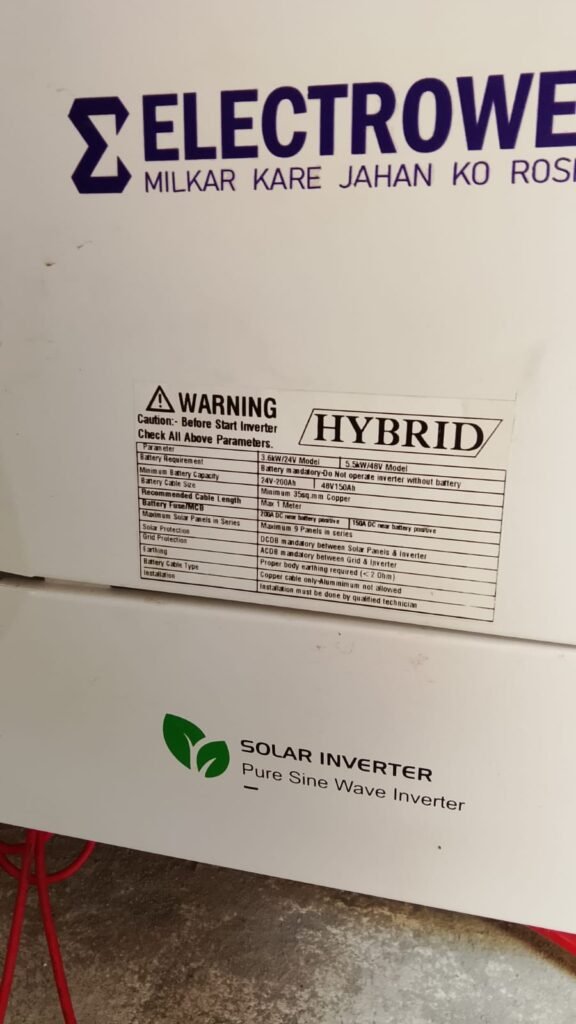
In the above image, you can see my 5 kW hybrid solar system with battery backup. So even during a power cut, our lights and other selected loads continue to work.
Remember, a normal on grid system and a hybrid system are not the same.
This is one point that should be very clear before installing solar.
Having solar panels does not automatically mean that you have power backup.
12. Can My Existing On Grid Solar Be Converted to Give Backup During Power Cuts?
You already have on grid solar.
Now you are thinking, can I just add a battery and use my solar during a power cut?
Sometimes it is possible, but it is not simply a matter of connecting a battery to the existing solar system.
First check what inverter and electrical arrangement you already have.
Depending on the system, backup may require a compatible hybrid inverter, a separate battery inverter, an AC coupled arrangement or another properly designed solution.
You can see my hybrid solar inverter and battery system below.
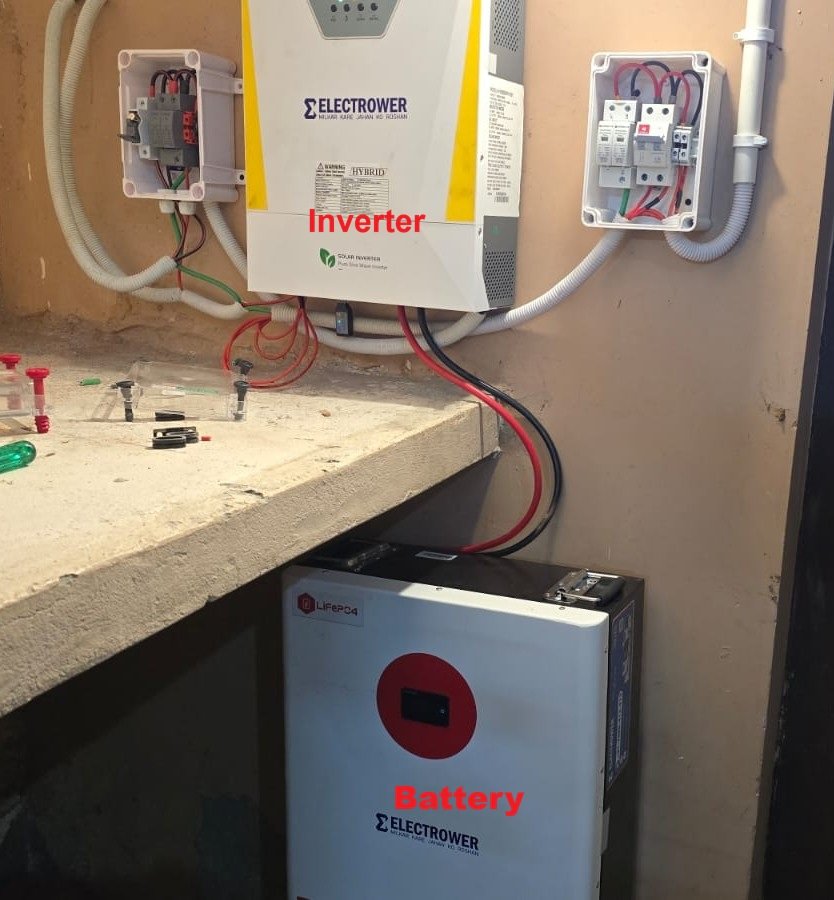
There is another question that is equally important.
What do you actually want to run during the power cut?
Suppose you only want two fans, a few lights, refrigerator and Wi Fi.
Now compare this with a house where the owner wants to run two ACs, a water pump, geyser and induction cooktop.
Can both houses use the same backup arrangement?
Obviously not.
This is why battery backup is not decided only by the size of your solar plant.
Your backup load and the number of hours you want to run it are equally important.
There is one more practical point.
If your area gets a ten minute power cut once in a month, the requirement is very different from a place where electricity goes off for three or four hours almost every day.
So before thinking about the battery, understand the existing solar system and the actual backup requirement.
Solar capacity tells us how much solar power can be generated. Battery capacity tells us how much energy can be stored. Backup load tells us how quickly that stored energy will be used.
These three numbers should not be mixed together.
13. Should I Add a Battery After Installing Rooftop Solar?
A battery solves a specific problem. First ask yourself, why do I need it?
Do you have frequent power cuts? Do you want to use your daytime solar generation at night? Or are you thinking that every rooftop solar system should have a battery?
No, a battery is not compulsory.
It stores electricity for later use and can provide backup if your system is designed for it. But it also increases the initial cost.
There are charging and discharging losses and the battery will also age with use.
So the calculation can be very different for two homes.
Suppose your area has a reliable grid and your present net metering arrangement gives reasonable value for exported electricity.
Storing the same electricity in an expensive battery may not necessarily save you more money.
Now take another house having two or three hours of power cuts every day. Here the owner may value backup much more.
I can see this clearly in my own 5 kW hybrid system. Solar panels, battery and grid work together, but each has a different job.
Interestingly, Indian homeowners are now asking another practical question. Can I install a hybrid inverter today and add the battery later?
In many systems this is possible, but only if the particular inverter supports battery less operation and the battery you add later is compatible with it.
India is also moving towards greater use of energy storage. The Draft National Electricity Policy 2026 talks about facilitating consumer owned storage with distributed renewable energy.
But it also identifies high upfront cost as one of the present constraints.
So understand a battery as storage and backup, not as a compulsory attachment to rooftop solar.
14. How Big a Battery Do I Need, and Can It Really Run My AC at Night?
Let us keep the calculation simple.
First find out what you actually want to run and for how many hours.
Required usable battery energy ≈ Backup load in kW × Backup hours
Suppose your lights, fans, refrigerator and other essential loads together consume around 0.6 kW and you want four hours of backup.
0.6 × 4 = 2.4 kWh
So you need about 2.4 kWh of usable energy for this simplified example.
Does it mean that a 2.4 kWh battery is enough?
Not necessarily.
A real system has inverter losses, battery operating limits, reserve capacity and ageing. Your load also keeps changing.
Now add an AC and the calculation changes quickly.
Suppose an AC draws an average of 1 kW for three hours. The AC alone would use around:
1 × 3 = 3 kWh
But an AC does not normally consume exactly the same power continuously. Room temperature, AC efficiency, thermostat setting, weather and compressor operation all affect consumption.
There is one more confusion I often see.
kWh tells you how much energy the battery can store.
kW tells you how much power the system can deliver at that time.
So a battery may contain enough energy to run an AC for a few hours, but the inverter and battery must also be capable of supplying the required power.
This is why asking only “How many Ah battery do I need?” does not tell the full story for a modern solar battery system.
15. Can I Add a Battery Without Replacing My Existing Solar Inverter?
Possibly, but first find out exactly which inverter you have.
A hybrid inverter may already be designed to work with specified batteries. In that case, a compatible battery can often be added later.
But what if you have a normal on grid solar inverter?
The answer is not simply, “connect a battery.”
A conventional grid connected inverter and a hybrid inverter are designed differently.
Battery storage may require another compatible arrangement such as AC coupled storage, or the existing inverter may need to be changed depending on the system design.
There is another question Indian homeowners are asking.
I already have a normal home inverter and battery. Can I keep it separately and install on grid solar?
Yes, these can exist as separate systems when properly designed.
Your rooftop solar can remain grid connected while the existing home inverter provides backup to selected loads during a power cut.
But in such an arrangement, the home battery may still be charging from the grid rather than directly from your rooftop solar.
This is different from an integrated hybrid solar system.
Also, do not match equipment only because both labels say 5 kW.
Battery voltage, communication, charging limits, inverter compatibility, backup output, single or three phase supply, wiring and electrical protection all matter.
The simplest starting point is the exact inverter model and its manual.
That small model number can tell you much more than the words “5 kW solar inverter.”
16. Why Does My Solar Inverter Keep Switching Off or Show Grid Over Voltage?
Have you noticed that the inverter works normally in the morning but trips around noon on bright sunny days?
The message may say Grid Over Voltage.
A grid connected solar inverter continuously monitors the electricity grid. If grid conditions move outside its permitted operating range, the inverter can disconnect.
But do not immediately blame the solar panels.
High grid voltage can come from local distribution conditions.
Voltage rise in the cable between your inverter and connection point can also contribute.
In areas having many rooftop solar systems, strong export during low local demand can further affect voltage conditions.
This is becoming more relevant as rooftop solar increases.
CEA planning documents recognize reverse power flow and the need to study distribution networks as distributed solar penetration increases.
India also has technical standards covering the connection of distributed generation to the grid.
What can you notice at home?
If Grid Over Voltage repeatedly appears at roughly the same sunny midday hours and disappears later, the timing itself is useful information.
The inverter event log and actual voltage recorded at that time can help identify what is happening.
Simply increasing the inverter voltage limit is not the same as solving the problem.
The protection is there for a reason.
Also remember that an inverter tripping because of grid voltage does not automatically mean the inverter is faulty.
The inverter may actually be responding to the grid condition exactly as it is designed to do.
17. My Solar Inverter Is Hot or Making Noise. Is This Normal?
Yes, some heating is normal.
Your solar inverter works for several hours converting DC electricity from the panels into usable AC electricity. During this process, some energy is lost as heat.
What about the noise?
That also depends on the inverter. Some inverters use cooling fans. The fan may run faster when the inverter is heavily loaded or its internal temperature rises.
So a fan becoming louder around peak solar generation does not automatically mean something is wrong.
Manufacturers also use temperature protection. If the inverter becomes too hot, it may reduce its output to protect itself. This is called temperature derating.
But suppose your inverter was normally quiet and suddenly starts making an unusual buzzing or grinding sound. Or it repeatedly shows a temperature alarm or shuts down.
That needs a closer look.
Poor ventilation, high surrounding temperature, dust around the cooling path or a cooling fan problem can contribute to overheating.
Do not decide that an inverter is overheating simply because its outer casing feels hot.
Some inverter surfaces can become surprisingly hot during normal operation. The actual temperature limits and cooling arrangement depend on the model.
So check the inverter display or app for an actual temperature warning and refer to the manual for your particular model.
A burning smell, smoke or signs of melted electrical parts are obviously not normal.
18. My Solar Monitoring App Says Offline. Has My Solar System Also Stopped?
Not necessarily.
This is one of those solar problems that looks more serious on the phone than it may actually be on the roof.
Think of your solar system as having two separate paths.
Power: Solar panels → inverter → home, grid or battery
Data: Inverter → WiFi or communication device → internet → cloud → mobile app
The data connection can fail while the inverter continues generating electricity.
Manufacturer documentation also treats power production and communication as separate functions.
For example, SolarEdge specifically states that a problem with one does not necessarily affect the other.
So if the app suddenly shows Offline, first see whether the inverter itself is showing normal operation and whether generation is visible on the inverter or meter where safely accessible.
Did you recently change your WiFi password or router?
That simple change can disconnect inverter monitoring even though nothing is wrong with solar generation.
Will I Lose My Solar Generation Data?
This is another question owners ask.
The answer depends on the inverter and monitoring system.
Some systems store production information locally and upload it after communication returns.
But storage capacity and the amount of historical detail retained vary by equipment.
SolarEdge, for example, says its inverter can retain production information during a communication outage, but detailed data can eventually be overwritten when local memory fills.
India is also moving towards better rooftop solar generation monitoring.
MNRE issued a notice on 17 August 2026 dealing specifically with inverter level generation data and storage of inverter level data for rooftop solar systems.
So an offline app and a non generating solar plant are not the same thing.
19. How Often Should I Actually Clean My Solar Panels?
Every week? Every 15 days? Once a month?
There is no single answer that works everywhere in India.
A house beside a dusty road in Rajasthan cannot follow the same cleaning schedule as a house in Kerala receiving regular rain.
The actual requirement depends on dust, bird droppings, nearby construction, pollution, panel tilt, rainfall and how quickly dirt collects at your location.
This confusion is very common among Indian solar owners. Some owners report cleaning weekly while others clean monthly or much less frequently.
Even recent owner discussions show that the frequency changes considerably with local dust conditions.
So how can you know what works for your house?
Your own solar generation can tell you.
Suppose the panels are visibly dusty. Note the generation before cleaning and then compare it after cleaning under reasonably similar sunny conditions.
If you repeatedly see a meaningful improvement, you will gradually understand how often your particular rooftop needs cleaning.
Cleaning every 15 days simply because somebody on YouTube said so may waste water and effort.
At the same time, leaving panels dirty for months in a dusty location can reduce generation.
There is no magic number.
Your location and actual panel condition decide the cleaning frequency.
20. Can I Clean Solar Panels With Borewell Water, Soap or a Pressure Washer?
Have you seen those white marks left on bathroom glass or taps after water dries?
That is the problem with hard water.
PM Surya Ghar rooftop solar training material says that water used for panel cleaning should be free from dirt and physical contaminants.
It says deionized water is preferable and specifically states that water having mineral content above 200 ppm should not be used.
So if you are using borewell water, do not assume it is suitable simply because the water looks clean.
What about soap?
The same training material allows a mild, noncaustic and nonabrasive detergent where required.
For normal cleaning when dirt is not clearly visible, water or a thinly diluted cleaning agent can be used.
Metal brushes should not be used. Stubborn bird droppings and dirt can be cleaned with a soft sponge, fiber cloth or nonabrasive brush.
What About a Pressure Washer?
This question appears repeatedly in Indian solar owner discussions. Some homeowners use pressure washers, while others use a normal water hose, wiper or long soft brush.
But what another homeowner uses is not automatically correct for your panels.
Check the cleaning instructions of your particular module manufacturer before using pressurized water. The module construction, seals and warranty requirements can differ.
And there is one bigger issue than cleaning.
Do you have to climb dangerously on the roof just to remove some dust?
Then losing a few units is not the main risk.
The PM Surya Ghar training material repeatedly warns against sitting, standing or walking on solar modules while cleaning them.
21. Rain Cleaned My Panels. Do I Still Need to Clean Them After Monsoon?
You may think that heavy monsoon rain has already cleaned the solar panels. So why clean them again?
Actually, rain can remove a lot of loose dust. But it does not mean that your panels are perfectly clean.
Bird droppings, sticky dirt and mud near the lower edge of the panel can still remain. Water can also leave marks after drying, particularly when the water contains dissolved minerals.
This is something solar owners are actually asking.
One rooftop solar owner from Trivandrum said that he normally relies on rain for cleaning.
He even noticed that generation improved after heavy rain. But he was still wondering whether the panels needed proper cleaning afterward.
So how do you know?
Look at your solar generation when clear weather returns.
Suppose your system normally generates around 20 units on a clear day during that season. After the monsoon, it is again producing close to that range and the panels look reasonably clean.
There may be nothing unusual.
But what if you can still see bird droppings, mud or other deposits and generation also remains lower than expected?
Then cleaning may be required.
Just remember one important point.
Do not compare a rainy July directly with a clear March.
Solar generation changes with sunlight, cloud cover, temperature and season. A fall during monsoon does not automatically mean that your panels are dirty.
For more on how location, weather and shading affect solar generation, you can also check the BharatGoGreen Home Solar Size Calculator India.
22. My Panels Are Clean but Generation Is Still Low. What Else Can Be Wrong?
You cleaned the panels but solar generation is still low.
Now what?
Clean glass is only one part of a rooftop solar plant.
Low generation can also happen because of new shading, a weak string, inverter derating, a module problem, damaged connection, insulation fault, repeated grid tripping or even incorrect monitoring data.
So first look at when the generation falls.
Is it low throughout the day?
Or does it fall sharply after 1 PM?
Does the inverter restart again and again?
For example, suppose a new building or tree starts shading one side of your solar array every afternoon.
Your panels may be perfectly clean, but generation can still fall during those hours.
Your old generation data can therefore tell you a lot.
Compare similar clear days from the same season. Look at the daily generation curve and check whether the inverter has recorded any error.
Sometimes the pattern itself gives the first clue.
But there is a limit to what we should check ourselves.
Opening DC connectors, junction boxes or the inverter is not the same as looking at the monitoring app.
Solar DC circuits can remain energised when sunlight is falling on the modules.
So a clean panel with low generation does not automatically mean that the panel itself is faulty. The problem can be somewhere else in the system.
23. My Inverter Says Normal. How Do I Know All My Solar Panels Are Actually Working?
The inverter shows a green light and says Normal.
Does that mean every solar panel on your roof is working properly?
Not necessarily.
A rooftop solar plant can continue generating even when one part of the system is underperforming.
For example, one string may be producing less. One module may have developed a problem.
A panel may be receiving new shade from a tree or water tank. Under certain shading or module conditions, bypass diodes can also become active while the remaining array continues producing power.
Your inverter may therefore continue showing normal operation.
So how would you know?
Your own generation history can give you the first warning.
Suppose your 5 kW system normally produces around 20 units on similar clear days during a particular season.
Now it repeatedly produces only 15 or 16 units under similar conditions.
There is no inverter alarm.
Would you simply ignore it because the inverter says Normal?
No. Something has changed and it needs to be understood.
A technician can compare MPPT or string data, inverter logs and electrical measurements.
Where required, thermal imaging or module level testing can also help locate an underperforming part of the array.
For us as homeowners, the first warning may therefore not be a red light on the inverter.
It may simply be an unexplained change in the generation pattern.
24. What Should I Check After a Storm, Strong Wind, Lightning or Heavy Monsoon?
A severe storm has passed and your rooftop solar system looks fine from below.
Is that enough?
Not always.
First look at the system from a safe place.
Are any panels visibly shifted?
Can you see broken glass, a bent structure, hanging cables or damaged conduit?
Is there water near the inverter or other electrical equipment?
Has the inverter started showing an alarm?
Do not climb onto a wet or visibly damaged roof just to inspect the solar panels.
Strong wind damage to rooftop structures can happen. Heavy rain can also expose weak cable entries, drainage problems or waterproofing issues that were not obvious earlier.
Now comes another common confusion.
Are earthing, surge protection and lightning protection the same thing?
No.
They are related, but they do different jobs.
Earthing provides a safe path for fault current and helps reduce electric shock risk.
A surge protection device protects electrical equipment against short duration overvoltage surges.
Lightning protection is designed to deal with lightning risk according to the installation and applicable protection requirements.
CEA requirements for solar plants separately refer to earth fault protection, surge protective devices and lightning protection. This itself tells us that one should not be treated as a replacement for another.
You may also hear statements such as:
“Every rooftop solar system must have exactly three earth pits.”
Is there one such number for every house in India?
No sensible universal number can be given without considering the system design, applicable standards and installation requirements.
The important question is not how many earth pits your neighbor has.
The important question is whether the electrical protection provided for your solar system has been properly designed and installed.
25. Can Rooftop Solar Cause Roof Leakage During Monsoon?
Solar panels themselves do not make your roof leak. But their installation can if the mounting work is not done properly.
Where can the problem come from?
Roof drilling, mounting points, cable entry, poor sealing, damaged waterproofing or improper drainage can allow rainwater to enter.
Sometimes you may not notice anything immediately. Then the first heavy monsoon arrives and a damp patch appears on the ceiling.
Does this mean solar has definitely caused it?
Not always.
Your roof may already have an old waterproofing problem. The installation work may also disturb an existing weak area. So the actual leakage point has to be identified.
Government rooftop solar specifications also require the installer to consider roof strength and carry out civil and structure work according to applicable standards.
Some government solar tender specifications specifically require that installation should not damage the roof and cause rainwater leakage later.
There is another small point we often ignore.
Water must drain freely from the roof. Solar foundations, cables or other structures should not create places where rainwater keeps collecting.
So rooftop solar and waterproofing should not be considered two completely separate jobs.
It is much easier to take care of waterproofing while installing solar than to repair the same roof after a large solar structure is already standing over it.
26. My Solar Installer Is Not Responding. What Happens to Maintenance and Warranty?
This is a real concern after rooftop solar installation.
The system may work perfectly for the first year. But what happens if the inverter develops a problem in the third year and your installer is no longer answering your calls?
For rooftop solar installed through a registered vendor under PM Surya Ghar, the rules are quite clear.
The registered vendor has to provide repairs and maintenance free of cost for five years from commissioning under the Comprehensive Maintenance Contract.
The complete system also has to carry a five year warranty from commissioning.
Individual components such as the solar panels and inverter may have their own manufacturer warranties, which the vendor has to provide to the consumer.
So keep your invoice, commissioning report, panel and inverter serial numbers, warranty certificates, system drawings and other documents safely.
But who should you contact when something goes wrong?
That depends on the problem.
If the inverter itself has failed, the inverter manufacturer and its warranty may be involved.
If there is a problem with installation or maintenance, it may come under the vendor’s responsibility.
If your problem is with the electricity meter or billing, it normally involves your DISCOM.
There is one more point worth knowing. The PM Surya Ghar model agreement states that a dispute between the consumer and vendor has to be settled between them mutually or as per law.
MNRE and the DISCOM do not automatically become parties to that dispute.
This is why your solar paperwork becomes very important after installation, not only while claiming the subsidy.
27. Can I Add More Solar Panels Later When I Buy an EV or More ACs?
Yes, solar capacity can often be increased later.
But adding one more panel is not always as simple as finding an empty space on the roof.
This exact confusion is appearing among Indian solar owners.
For example, one homeowner had 4.8 kWp of solar panels connected to a 4 kW inverter and wanted to add another 600 W panel. His question was simple.
Can my existing inverter take it?
That is actually the right question.
Every inverter has limits for maximum DC input, MPPT voltage and input current. The existing string arrangement also matters.
Suppose you have plenty of empty roof space. Does that automatically mean you can keep adding panels?
No.
The inverter may become the limiting factor. The new panel may also need to match the electrical characteristics of the existing panels.
There is another side to it.
If you bought an EV or added two ACs, your electricity consumption itself has changed. So first calculate your new requirement.
Also remember that increasing the installed solar capacity may involve your sanctioned rooftop capacity and the applicable DISCOM metering rules.
So the roof space is only one part of the calculation.
The inverter, panels, electricity consumption and approved grid connection all have to work together.
28. I Live in an Apartment. How Does RWA or Society Rooftop Solar Benefit Residents?
This question is becoming more common as large housing societies start looking at rooftop solar.
Suppose your society installs solar panels on the common terrace.
Will those solar units automatically come into your individual flat meter?
Not necessarily.
Under PM Surya Ghar, Group Housing Societies and RWAs can receive support for rooftop solar used for eligible common facilities, including EV charging, subject to the scheme conditions.
Think about how much electricity a large society itself consumes.
Lifts are running throughout the day. Water pumps operate regularly. Then there are corridor lights, parking lights, security systems, clubhouse loads and common EV chargers.
Rooftop solar can meet part of these common electricity requirements.
If the society buys less electricity from the grid for these loads, its common electricity expense can come down.
The financial benefit may therefore appear in society expenses rather than directly as fewer units on your personal electricity bill.
There is another possibility.
PM Surya Ghar guidelines also recognize Group Net Metering and Virtual Net Metering where such arrangements are approved by the DISCOM.
So apartment solar does not have only one billing model across India.
Before comparing two society solar projects, look at the common area electricity consumption, available roof area, expected solar generation and the metering arrangement approved by the local DISCOM.
That will tell you much more than simply asking, “How many kW of solar is our society installing?”
29. What Happens to My Panels, Inverter and Battery as They Get Old?
You may have heard that solar panels come with a 25 year warranty.
But does it mean your complete rooftop solar system is covered for 25 years?
No.
This is where some confusion starts.
Solar modules normally have separate product and performance warranty terms.
A performance warranty mainly tells you how much output the manufacturer guarantees after a certain number of years.
It does not mean that every panel will continue producing exactly the same power for 25 years.
The permitted reduction also depends on the particular manufacturer and module. So I would not apply one common degradation percentage to every solar panel.
The inverter and battery are different again. Their warranty and expected life can be much shorter than the solar modules.
This is also something owners are asking after installation. If the panel has a long warranty but the inverter fails earlier, who will handle the claim? The installer or the manufacturer? What documents will be required?
Therefore, keep the invoice, module and inverter serial numbers, warranty documents and installation records safely.
A WhatsApp message from the installer is not your warranty document.
What Happens When Solar Panels Finally Become Waste?
There is another question that we rarely think about while installing solar.
What will happen to millions of panels when they finally reach the end of their useful life?
India’s E Waste Management Rules, 2022 specifically cover solar photovoltaic modules, panels and cells. The rules also place responsibilities on manufacturers and producers for managing this waste.
The scale can become quite large.
In March 2026, the Government of India reported an estimate prepared with support from MNRE that cumulative waste from India’s existing and projected solar installations could reach around 600 kilotonnes by 2030.
That is not 600 kilotonnes of household rooftop panels alone. It covers waste expected from India’s wider existing and projected solar capacity.
What about batteries?
Waste batteries come under the separate Battery Waste Management Rules, 2022. These rules cover different battery categories and use Extended Producer Responsibility for collection, recycling and refurbishment.
So an old solar battery or damaged solar panel should not be treated like normal household garbage.
This is going to become a much bigger question as India’s first large generations of solar systems get older.
You can also read our basic explanation of solar energy and other renewable energy topics.
30. If Every House Installs Rooftop Solar, Can the Local Grid Handle It?
Let us take a simple example.
Imagine ten houses in a street.
Only one house has rooftop solar. During the afternoon it may export some extra electricity to the grid.
Now imagine eight houses have solar.
At noon, most families may be using less electricity while all those solar systems are generating together.
So where will the extra electricity go?
It starts flowing back through the local distribution network.
This does not mean that installing more rooftop solar is a problem. But the electricity network also has to be ready for a large amount of distributed solar.
CEA says that higher rooftop solar penetration at the distribution transformer level may require network upgrades on a case to case basis where reverse power flow occurs.
Grid balancing, forecasting, voltage regulation and anti islanding also become more important as rooftop solar increases.
So yes, a local grid can handle rooftop solar, but how much it can comfortably handle depends on the actual distribution network and the solar penetration in that area.
Will Batteries Become Necessary in the Future?
This is another interesting question.
Suppose your rooftop generates maximum electricity around noon, but much of your household consumption comes in the evening.
Today, excess electricity may be exported according to the metering and settlement rules applicable in your state.
A battery gives another option. Some of that electricity can be stored and used later.
The Draft National Electricity Policy 2026 gives a clear indication of this direction. It proposes promoting rooftop solar with storage and consumer owned energy storage.
It also proposes promoting storage instead of depending on power banking and discouraging net metering beyond 5 kW.
But please note one important word here.
Draft.
This is a proposed national policy direction. It does not mean that net metering above 5 kW has suddenly stopped across India.
Present rules still depend on the applicable regulations and your DISCOM.
There is another possibility which does not always need a battery.
Can we use more of our solar electricity when it is actually being generated?
Yes.
For example, EV charging, water pumping and some other flexible household loads can be shifted towards solar hours where practical.
Instead of exporting electricity at noon and taking electricity back later, more solar power gets consumed directly inside the house.
As rooftop solar grows, therefore, the question may slowly change from only “How much solar can I install?” to “How much of my solar electricity can I use when it is available?”
External reference: CEA Electricity Distribution Network Planning Criteria
A Simple Monthly Solar Check
How will you know after two years whether your solar generation has actually fallen?
Your memory may not help much.
Once a month, note five simple things.
- Solar generation
- Grid import
- Grid export
- Electricity bill
- Any repeated inverter alarm
Also look for any obvious physical change around the panels. A growing tree or a new water tank can create a shadow that was not there when the system was installed.
After one full year, you will have your own seasonal solar record.
Then instead of saying, “I think my generation is low”, you can ask a much better question.
“Why did my system generate much less this September than last September?”
That comparison can tell you much more than comparing September with April because solar generation naturally changes with season and weather.
One Important Safety Point
Checking your solar app or electricity bill is one thing.
Opening an inverter, connector or electrical panel is completely different.
Solar panels can produce DC electricity whenever sufficient light falls on them. Therefore, switching off the grid does not automatically mean that every solar cable and connector has become electrically dead.
What if you see smoke, a burning smell, sparking, melted connectors, damaged cables or water entering electrical equipment?
That is not the time for trial and error.
The same applies to broken modules and repeated electrical protection trips.
You can safely observe the system and record what is happening. Electrical testing and repair should be handled by a properly qualified person.
Solar is expected to remain on your roof for many years. Understanding what is normal and what is not can therefore be as important as selecting the right system in the first place.
References
- Press Information Bureau, Government of India. PM Surya Ghar: Muft Bijli Yojana crosses 50.06 lakh beneficiary households. Ministry of New and Renewable Energy, Government of India, 4 August 2026.
- Ministry of New and Renewable Energy, Government of India. Compliance of Guidelines Issued by MNRE Regarding Inverter Level Generation Data and Storage of Inverter Level Data of Rooftop Solar Systems. MNRE, 17 August 2026.
- Central Electricity Authority, Government of India. Revised Distribution Planning Criteria. Central Electricity Authority, Ministry of Power, Government of India, 2024.
- Central Electricity Authority, Government of India. Technical Standards for Connectivity to the Grid and Related Regulations. Central Electricity Authority, Ministry of Power, Government of India.
- Ministry of New and Renewable Energy, Government of India. PM Surya Ghar: Muft Bijli Yojana Guidelines for Central Financial Assistance to Residential Consumers under Capex Mode. Includes provisions applicable to residential consumers and Group Housing Societies and Resident Welfare Associations.
- Lok Sabha, Parliament of India, Government of India. Parliamentary material on PM Surya Ghar: Muft Bijli Yojana covering maintenance requirements and OEM warranty provisions. Government of India.
- National Instructional Media Institute. Rooftop Solar PV Trainer. PM Surya Ghar training material covering rooftop solar installation, operation, maintenance and related technical practices.
- Press Information Bureau, Government of India. Government information on solar photovoltaic waste management and circular economy. Government of India, 17 March 2026. Includes estimates of future solar PV waste generation in India and the applicable waste management framework.
- Ministry of Environment, Forest and Climate Change, Government of India. Rules and Regulations relating to waste management. Includes the regulatory framework relevant to electronic waste and batteries in India.
- Ministry of Environment, Forest and Climate Change, Government of India. Battery Waste Management Rules, 2022. Government of India, 2022. Also listed by the Ministry of New and Renewable Energy.
- Ministry of Power, Government of India. Draft National Electricity Policy 2026. Draft policy document covering India’s electricity sector, including rooftop solar, energy storage, banking and related distributed energy issues. Draft document and not a final nationwide rule.
- Ministry of New and Renewable Energy, Government of India. PM Surya Ghar: Muft Bijli Yojana National Portal. Official scheme information and context relating to rooftop solar applications, vendors, subsidies and DISCOM processes.
- Reddit, r/lucknow. Homeowner discussion concerning rooftop solar generation, exported electricity and a high electricity bill. Used only to identify a real question being raised by an Indian rooftop solar owner and not as a technical or regulatory source.
- Reddit, r/chennaicity. Homeowner discussion concerning an unusually high electricity bill and abnormal import reading after installation of a 9.86 kW rooftop solar system. Used as an anecdotal homeowner example only.
- Reddit, r/Goa. Homeowner discussion concerning rooftop solar generation and continued electricity bill charges. Used to identify practical consumer confusion after rooftop solar installation and not as technical evidence.
- Team-BHP. Solar Power! Turning My Roof to a Power Plant. Community discussion containing long-term rooftop solar ownership experiences, generation observations, billing questions, power-cut behaviour and other practical issues. Used mainly for identifying questions faced by actual solar owners.
- Team-BHP. Optimising Residential Rooftop Solar Panels. Community discussion covering practical experiences with residential rooftop solar performance and optimisation. Used for homeowner question discovery and practical context rather than as a regulatory or technical authority.
Research Note: Government, MNRE, CEA, Ministry of Power and other primary documents have been used for technical, regulatory and scheme-related claims. Reddit and Team-BHP discussions have been used only to understand the actual questions and problems being discussed by rooftop solar owners. State regulations and DISCOM procedures can differ across India.