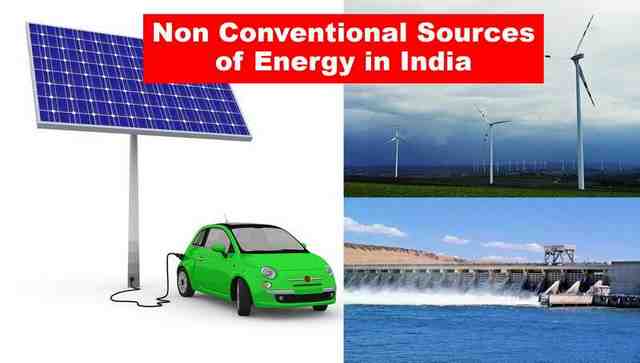
Rooftop solar is becoming common in India. As on 12 August 2026, more than 51.58 lakh households had already benefited from rooftop solar under PM Surya Ghar.
So, if you have also decided to install solar on your roof, the next question is obvious.
How Much Solar Do I Need for My Home?
Should I install 2 kW, 3 kW, 5 kW or even more?
You may ask three solar vendors and get three different answers.
One may suggest 3 kW because the maximum central subsidy is available up to this capacity.
Another may suggest 5 kW because you have enough roof space.
Someone may even tell you to install as much solar as possible because your electricity use can increase in the future.
Now whom should you believe?
Actually, there is no common answer for every house.
The right solar size mainly depends on how much electricity you use, where you live, how much usable roof area you have and whether your electricity use is likely to increase in the coming years.
For example, a family using 250 units per month may not need the same solar capacity as another family using 600 units.
Even two families using the same electricity today may require different capacities if one of them is planning to buy an EV or install more air conditioners.
I have also installed a 5 kW rooftop solar system at my own home. So apart from the technical side, I have gone through many of the same questions that normally come to our mind before installing solar.
How much solar do I actually need? Is 3 kW enough or should I go for 5 kW? How much roof area is required? What should I check in the vendor quotation?
I can therefore understand these doubts quite well.
Let us discuss them one by one in a simple way.
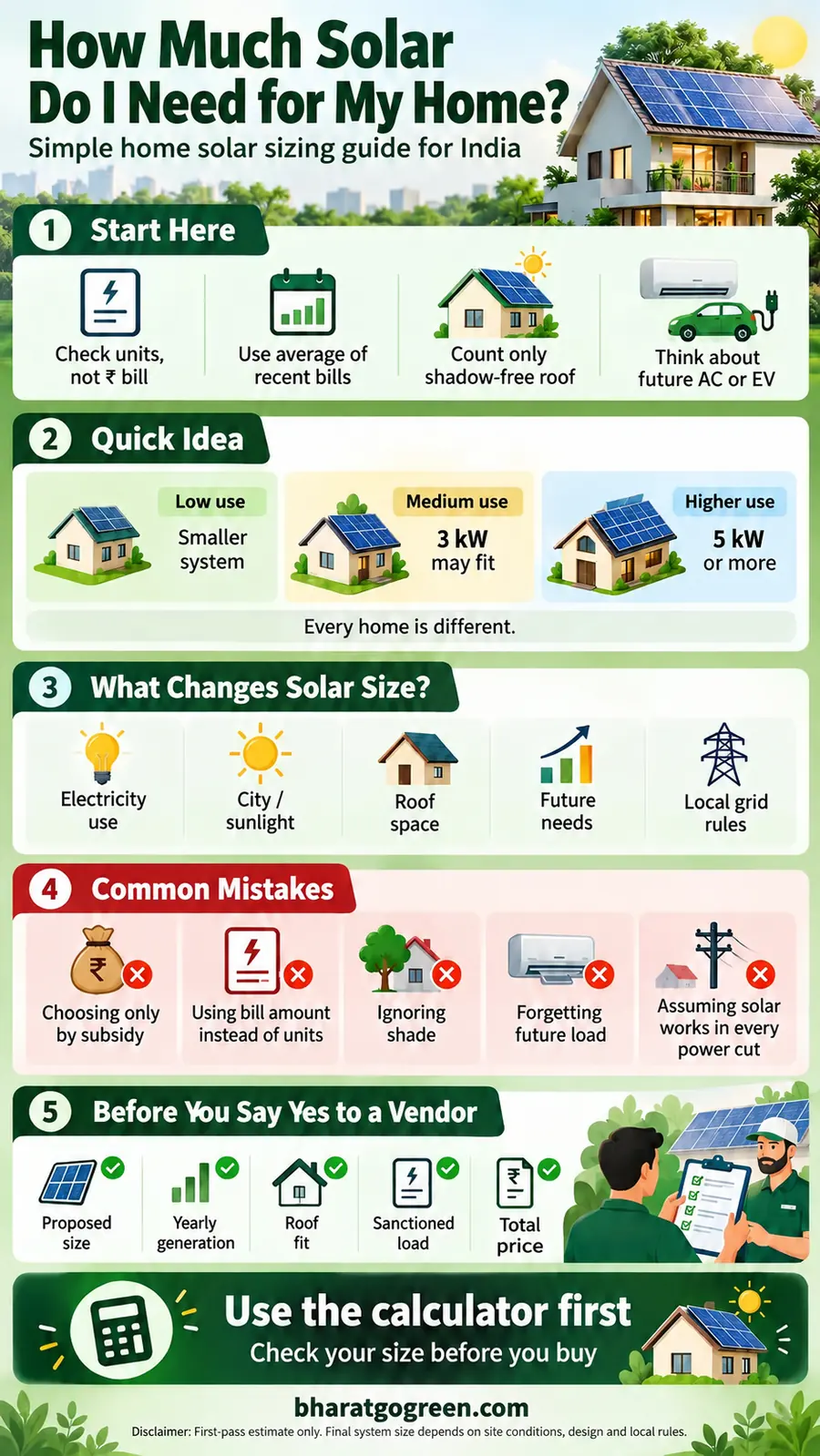
How Much Solar Do I Need for My Home| What to Check?
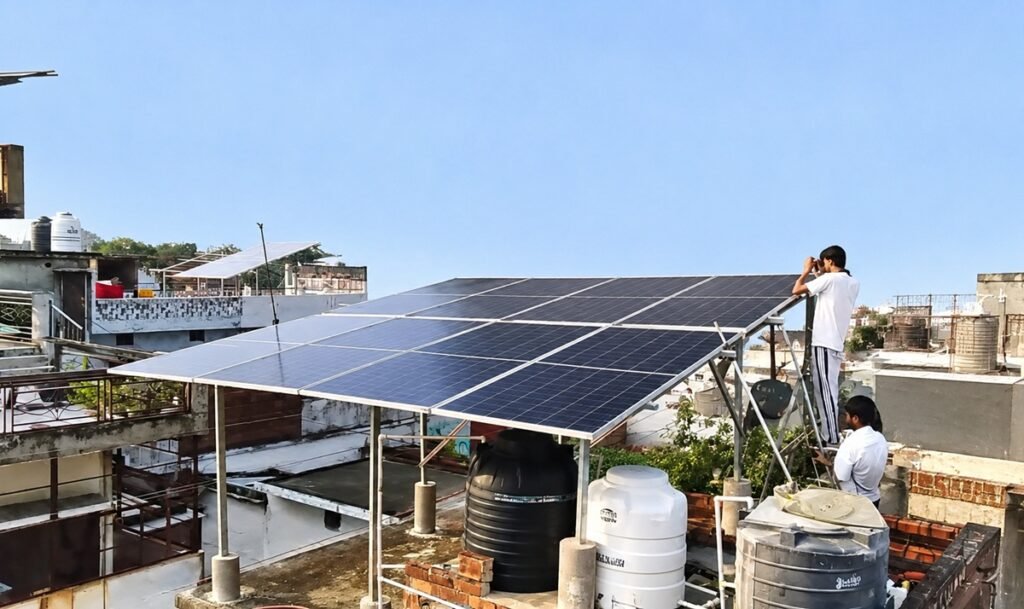
First you have to check your total units and not the Electricity Bill Amount.
Suppose your electricity bill is ₹3,500 per month.
Can we say that you need a 3 kW solar system?
No.
The bill amount alone cannot tell us the required solar size.
Electricity tariffs are different in different states. There are also tariff slabs, fixed charges and other charges in your electricity bill.
So what should you check?
Look for Units Consumed or kWh on your electricity bill.
One unit of electricity is one kWh.
A kWh simply means that we are using 1,000 watts of electrical power for one hour. For example, if a 1000 watt heater runs for one hour then it uses about one unit of electricity.
So, these units tell us how much electricity your house has actually used.
Also, do not depend only on one month’s bill.
Think about a house in Delhi or Jaipur. Electricity use can increase sharply during summer because of air conditioners.
The same house may use much less electricity during winter.
Therefore, a full year’s electricity consumption gives a better picture.
Do not have all twelve bills?
No problem.
Use an average of several recent bills. Just make sure that the average reasonably represents your normal electricity use.
Use the Home Solar Size Calculator
Now comes the easy part.
You do not need to calculate the solar capacity yourself.
Enter your electricity use and location in the BharatGoGreen Home Solar Size Calculator India.
The calculator will estimate the approximate solar capacity required for your home.
Do you have enough roof space? You can enter the usable roof area also.
Are you planning to install another AC, buy an EV or add more rooms? You can include the expected increase in electricity use as well.
The calculator gives you an approximate solar requirement and also shows nearby practical system sizes.
You can see how much electricity these different sizes may generate in a year.
What if a solar vendor has already given you a quotation? You can use the Advanced Check a Vendor Quote option.
Enter the capacity proposed by the vendor and the annual generation promised in the quotation. The calculator will compare these numbers with a simple planning reference for your location.
This does not mean that the vendor is wrong if his estimate is slightly different.
Every roof is different. There may be some shade, the roof direction may be different or the panel angle may not be the same.
So use the calculator as a first check. It will help you understand whether the size suggested by the vendor looks reasonable before you take the final decision.
3 kW or 5 kW Solar? Start With Your Actual Use
Should you install a 3 kW solar system or spend more and go for 5 kW for the next 10 to 15 years?
This is one of the most common questions among homeowners planning rooftop solar in India. The problem is that there is no common answer for every house.
Let us take a simple example.
Suppose a family normally consumes around 250 units of electricity every month. They do not plan to buy an electric car or add more air conditioners in the near future.
In such a case, installing a much bigger solar system only because there is enough space on the roof may not be necessary.
Now consider another family using the same 250 units today. They are planning to install two air conditioners and buy an electric car next year.
Will their future electricity requirement remain the same?
Obviously not.
This is why you should not select your solar capacity only from the electricity you are using today.
At the same time, there is no need to buy a much bigger system without any real requirement.
Our Home Solar Size Calculator allows you to add the expected increase in electricity use so that you can check a more practical solar size for your home.
Think About ACs, an EV and Future Electricity Use
Solar panels are not something that you install for one or two years. They are expected to remain on your roof for many years.
So it is sensible to think a little ahead.
Are you planning to install another AC? Do you expect to buy an electric car? Are you adding another floor or giving part of the house to a tenant?
All these changes can increase your electricity consumption.
But there is another common misunderstanding.
Suppose you plan to buy an EV with a 7 kW home charger. Does it mean you need another 7 kW of solar?
No.
The charger rating tells you how much power it can draw at a particular time. It does not tell you how much electricity your car will consume over the whole month.
The same is true for an air conditioner. You cannot simply take the AC capacity and add the same number to your solar requirement.
What matters is the additional electricity you are likely to consume.
If you already have a reasonable idea of the extra monthly units, enter them in the calculator.
If you are still not sure, do not add an unnecessarily large number only to make the system future ready.
Does Your City Make a Difference?
Yes, it does.
A 3 kW solar system installed in one part of India will not necessarily generate exactly the same electricity as another 3 kW system installed somewhere else.
Why?
The amount of solar energy available changes with location. Weather conditions also change throughout the year.
Even two houses in the same city can get different results because one roof may remain completely open while another receives shade from a nearby building or water tank.
The Ministry of New and Renewable Energy states that most parts of India receive around 4 to 7 kWh of solar energy per square metre per day.
This is why statements such as “1 kW solar will always generate a fixed number of units” should be taken only as a rough estimate.
The BharatGoGreen calculator uses rounded solar planning values for different cities.
Even if you are living in smaller towns, you can still use the calculator.
If your city or PIN is available, select it. If it is not available, simply enter your town or village manually and select your State or Union Territory. The calculator will then use a broader state level solar reference.
Will this give the exact generation from your rooftop?
No.
Nobody can know the exact generation without considering the actual site, shading, roof direction, panel angle, weather and installation quality.
However, it gives you a useful first estimate to understand whether your home may need something closer to 3 kW, 5 kW or another solar capacity.
That is exactly what the calculator is meant to do.
How Much Roof Space Is Actually Available?
You may have a large terrace, but does it mean that the entire area can be used for solar panels?
Usually not.
Look at your roof carefully. There may be a water tank, staircase room, pipelines or some other construction.
A nearby building or tree may also create shade during some part of the day. You also need some free space to reach the panels for cleaning and maintenance.
So it is the usable roof area that matters, not the total area of your terrace.
The official rooftop solar FAQ says that a 1 kW solar system generally requires around 10 square metres of shadow free roof area. This is about 108 square feet.
The actual space can change depending on the size and efficiency of panels and how they are arranged on the roof.
Suppose your terrace is 1,000 square feet. You should not simply assume that it can accommodate around 9 kW of solar. If a large water tank and staircase occupy the roof and another part remains in shade, the usable area may be much less.
That is why our calculator asks for usable shadow free roof area.
Not sure about it? You can leave this field blank. The solar installer should finally visit your house and check the actual panel layout and shadow conditions.
Should You Install Only 3 kW Because the Subsidy Stops There?
This is another common question.
Under the present PM Surya Ghar scheme, the standard Central Financial Assistance is ₹30,000 per kW for the first 2 kW and another ₹18,000 for the next 1 kW.
Therefore, the usual maximum central subsidy becomes ₹78,000 for a 3 kW or larger residential system. The government was still reporting subsidy support of up to ₹78,000 in 2026.
So should every homeowner stop at 3 kW?
No, because subsidy and electricity requirement are two different things.
Suppose your electricity use and future requirement suggest that a 5 kW system will be more suitable.
Installing only 3 kW just because the subsidy does not increase further may leave a large part of your electricity requirement uncovered.
The opposite can also happen. If your electricity consumption is low, installing 5 kW simply because somebody says bigger is always better may not make sense.
First find out how much solar your home approximately needs. Then check how the subsidy changes the final cost.
Will a Bigger Solar System Always Save More Money?
You may think that more panels will always give more savings.
It is not so simple.
A bigger solar system will normally generate more electricity. But the important question is what happens to that electricity.
Part of the solar power may be used directly in your house during the day. Extra electricity may be exported to the grid depending on the metering arrangement allowed by your electricity distribution company.
The value and adjustment of this exported electricity can vary with the applicable state regulations and DISCOM rules.
Sanctioned load is another point that should not be ignored.
Suppose your connection has a sanctioned load of 3 kW and a vendor proposes a 5 kW rooftop system.
Does it mean that the proposal is wrong?
Not necessarily.
But you should check the applicable rule with your DISCOM before accepting the quotation because rooftop solar connection requirements can differ between states and electricity distribution companies.
This is also why the BharatGoGreen vendor quote checker gives you a warning when the proposed solar capacity is above the sanctioned load entered by you.
The idea is not to install the maximum number of solar panels that can fit on your roof.
The better approach is to install a practical solar size that suits your electricity use, roof and future requirement.
Will Rooftop Solar Work During a Power Cut?
You have installed solar panels on your roof. It is a bright sunny afternoon and suddenly the electricity supply goes off.
Will your solar panels continue to run the house?
In a normal grid connected solar system, the answer is usually no.
You may wonder why the system should stop when enough sunlight is available outside.
There is an important safety reason behind it.
A grid connected inverter has anti islanding protection. When it detects that the grid supply has failed, it stops sending solar electricity to the grid.
Why is this required?
Suppose an electricity department worker is repairing a power line after a shutdown. If a rooftop solar system continues sending electricity into that line, it can create a serious safety risk.
Therefore, a normal grid connected solar system shuts down during a power cut.
What if you want electricity backup during frequent power cuts?
In that case, you need to discuss a suitable hybrid system, battery system or another properly designed backup arrangement with your installer.
Simply adding more solar panels will not solve the problem.
The BharatGoGreen Home Solar Size Calculator is also designed for a normal grid connected home solar system.
Battery backup is a different requirement and needs a separate calculation.
Check What the Solar Vendor Is Promising
You have received a quotation from a solar vendor. What should you check first?
Many people immediately look at the total price.
Price is important, but it should not be the only thing you check.
First see the solar capacity proposed by the vendor. Then check the annual electricity generation mentioned in the quotation.
You should also see whether enough usable roof area is available for that system.
If you know your sanctioned electricity load, check that as well.
Let us take a simple example.
Suppose your electricity consumption suggests that a system of around 3.5 kW may be suitable, but the vendor recommends 5 kW.
Does it mean the vendor is wrong?
Not necessarily.
Maybe your future electricity requirement has been considered. You may be planning another AC, an electric vehicle or additional rooms. The selected panel sizes and roof layout may also result in a slightly different installed capacity.
But there should be a reason for the difference.
So ask the vendor.
Another important question is annual generation.
If a vendor promises much higher generation than what you normally expect for your location, ask how this figure was calculated.
Has the vendor checked the shadow on your roof? What roof direction and panel angle have been considered?
Are the figures based on ideal conditions or realistic yearly generation?
These are common questions people are asking in recent rooftop solar discussions.
Homeowners are comparing 3 kW and 5 kW systems, different quotations, expected generation and even whether the inverter should be kept larger for future expansion.
You do not need to become a solar expert to check all this.
Use the Advanced Check a Vendor Quote option in the BharatGoGreen calculator.
It compares the proposed solar size and annual generation with the planning reference used for your location.
It does not decide whether a particular brand or vendor is good or bad.
It simply helps you understand the quotation better and ask the right questions before spending your money.
How Much Solar Do I Need for My Home in India (FAQs)
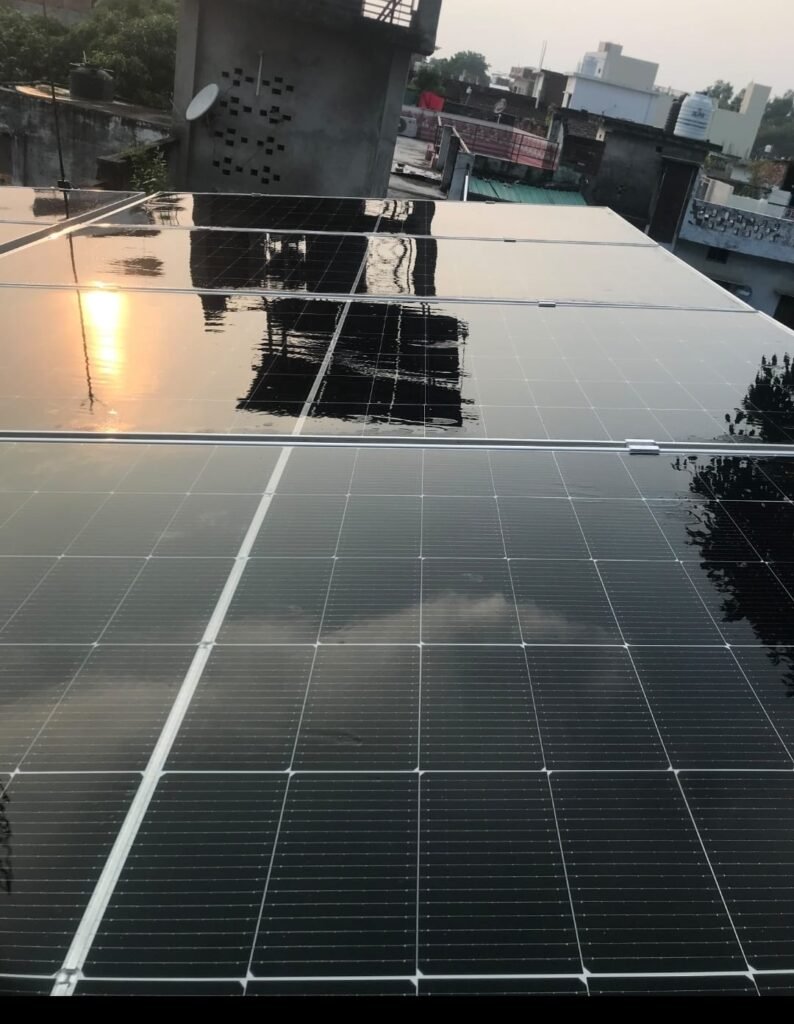
My present electricity bill is low, but I am planning to install ACs later. Which consumption should I use?
Your electricity use today may be low, but it can increase considerably once you start using more air conditioners or other electrical appliances.
So what should you do?
Use your present electricity consumption as the starting point. Then add a reasonable estimate for the extra electricity you expect to use in future.
For example, if you are planning two new ACs or an electric car, it does not make much sense to select the solar size only from your present low consumption.
Solar panels will remain on your roof for many years. Therefore, it is better to think a little ahead.
My city is not available in the calculator. Can I still use it?
Yes, you can.
India has thousands of towns and villages, so it is not practical to list every place separately.
If your city or PIN is not available, enter your town or village manually and select your State or Union Territory. The calculator will then use a broader state level solar reference.
The result will still be useful for an initial estimate. However, the actual generation from your roof can be different because of local weather, shading, roof direction and other site conditions.
The vendor recommends 5 kW, but my neighbor has installed only 3 kW. Who is right?
Your neighbor’s solar system should not become the standard for your house.
Your neighbor may use less electricity. He may have a smaller roof. He may not use many ACs or may have no plan to buy an EV.
Your requirement can be completely different even if both houses are next to each other.
Therefore, compare the proposed solar size with your own electricity consumption and future requirement.
Can I trust the annual generation mentioned in the quotation?
Consider it as an estimate, not a guarantee.
Solar generation depends on your location, shading, roof direction, panel angle, weather, equipment and installation quality.
If the generation promised by the vendor looks unusually high, ask a simple question.
How have you calculated this figure for my location and roof?
A good vendor should be able to explain it clearly.
Should I use the electricity bill amount if I cannot find the units?
Try to find the value written as Units Consumed or kWh on your electricity bill.
This is much better for estimating solar size than using the bill amount in rupees.
Your electricity bill can change because of tariff slabs, fixed charges and other charges. The units consumed tell us how much electricity your home has actually used.
So How Much Solar Do You Need for your Home?
By now, you may have understood that there is no common answer such as every Indian house needs 3 kW solar.
One family may be comfortable with a smaller system, while another family in the same locality may need 5 kW or even more.
Start with your electricity units. Check your location. Think about your future electricity use. Also see how much usable roof area is actually available without major shade.
You do not have to calculate all these things yourself.
Use our Home Solar Size Calculator and enter a few basic details. It will give you an approximate solar requirement and nearby practical sizes to consider.
Already received a quotation from a solar vendor?
Use the advanced option in the same calculator. You can compare the size proposed by the vendor and the annual generation mentioned in the quotation with a simple location based reference.
Remember that the calculator gives you a good starting point. Your final system still needs to be checked at your home because roof conditions, electrical connection and DISCOM requirements can be different.
So, How Much Solar Do you need for your home? Is it 3 kW, 5 kW or something else?
You can share your electricity consumption and location in the comments.
It may also help other readers who are trying to make the same decision.
More to Read on BharatGoGreen
- What is Solar Energy? Uses, Advantages and Disadvantages
- Top 8 Important Non Conventional Sources of Energy in India
References and Current Official Sources
- PM Surya Ghar progress as of August 2026, Press Information Bureau
- PM Surya Ghar Central Financial Assistance guidelines, National Portal for Rooftop Solar
- Rooftop Solar FAQ, National Portal for Rooftop Solar
- Solar Overview, Ministry of New and Renewable Energy
- Technical requirement for grid islanding protection, National Portal for Rooftop Solar
- DISCOM portal links, National Portal for Rooftop Solar