A small wind turbine on the roof looks quite attractive. It can rotate in the morning, at night and even on a cloudy day.
So a natural question comes to mind.
If rooftop solar is becoming common in India, why not install a wind turbine as well and generate electricity for more hours?
The idea looks simple and it is technically possible. But does a rotating wind turbine always mean that it is generating useful electricity?
The answer is no.
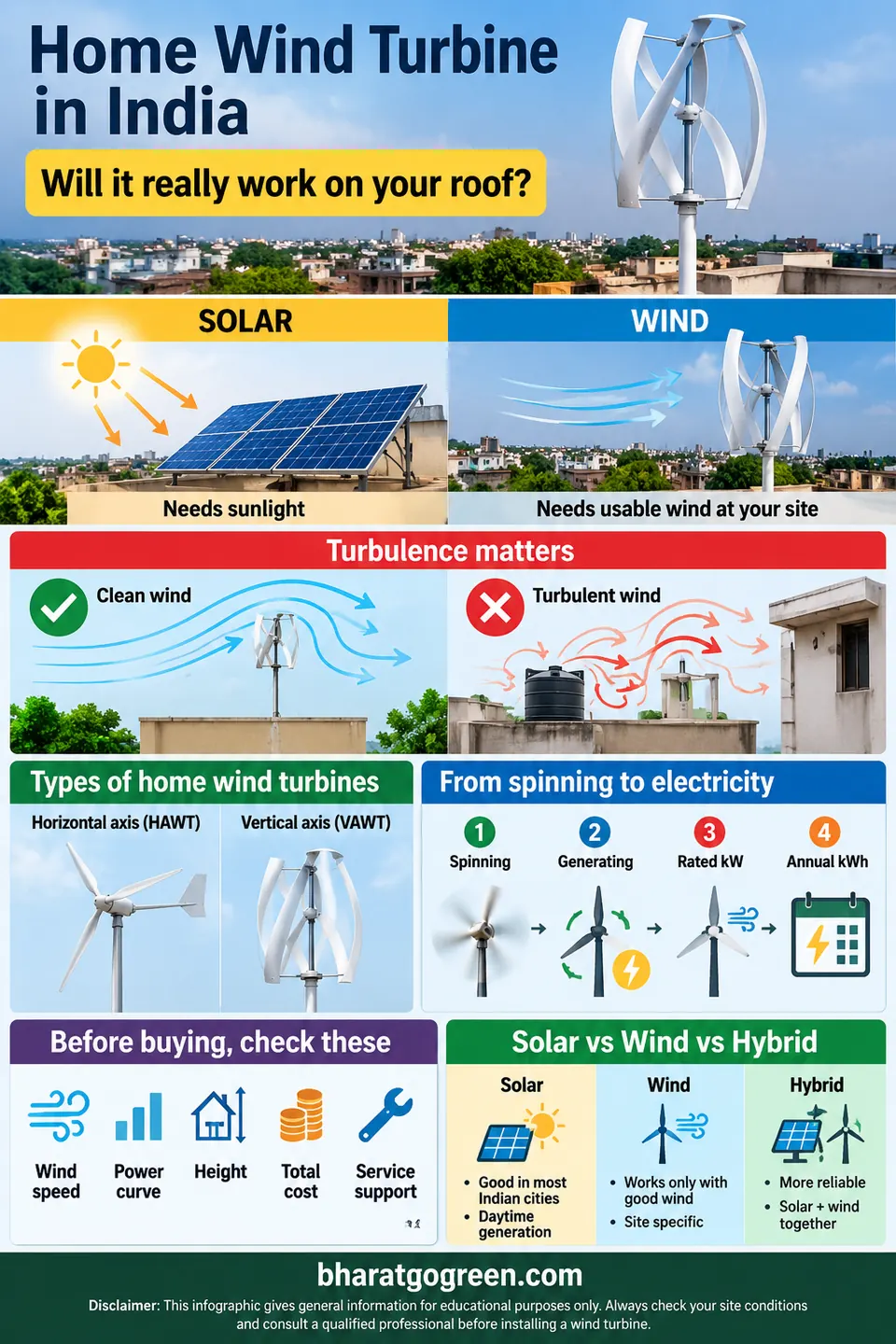
A wind turbine needs more than just some wind. It needs enough useful wind at the exact place where the rotor is installed.
Nearby buildings, trees, water tanks and even the shape of your roof can affect the wind reaching the turbine.
Sometimes, you may see the blades rotating continuously while the actual electricity generation remains very low.
So, I would not start by asking whether I should buy a 1 kW or 2 kW wind turbine.
The first question should be much simpler.
Is there enough useful wind on my roof?
You have to first check the location, roof height, nearby buildings and actual wind conditions.
If the wind is suitable, then we can think about turbine size, electricity generation and cost.
Can You Install a Wind Turbine on a House in India?
Yes. Small wind turbines are real technology and they can be installed for household use in India.
The National Institute of Wind Energy says that it tests small wind turbine systems and rooftop aerogenerators used in homes for battery charging as well as grid connected applications.
NIWE mentions systems ranging from around 0.3 kW to 15 kW.
But does this mean that you can simply install a wind turbine on any terrace and start generating electricity?
The answer is no.
Just think of two houses. One is a farmhouse with open land around it and almost nothing blocking the wind.
The other is a house in a crowded city where taller buildings, a water tank, trees and a high parapet surround the terrace.
Now install the same 1 kW wind turbine at both places.
Do you think both will generate the same amount of electricity?
Certainly not.
Wind reaching the second house may be slower and highly disturbed by nearby buildings.
Therefore, installation is one thing and useful electricity generation is another.
So, can you install a wind turbine at home?
Possibly yes.
But the more important question is:
Will it generate enough electricity at your particular house to justify its cost?
That is what we need to find out before buying one.
Why a 1 kW Wind Turbine Does Not Give 1 kW All the Time?
Suppose you see a 1 kW wind turbine advertised online.
What does this 1 kW actually mean?
It is the rated power of the turbine. It does not mean that the turbine will continuously produce 1 kW whenever its blades are rotating.
A wind turbine has different operating stages.
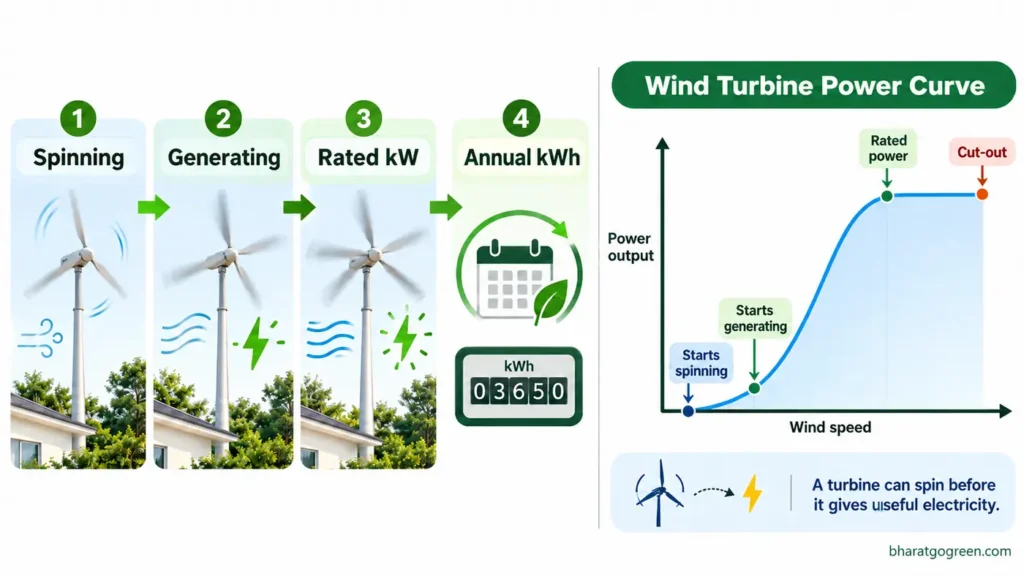
At a low wind speed, its blades may only start rotating. As wind speed increases, electrical output starts rising.
The turbine reaches its rated power only when the wind reaches the rated wind speed specified for that particular model.
The US Department of Energy also defines rated wind speed as the lowest wind speed at which the turbine produces its rated output.
This is an important point because you may find advertisements highlighting a very low start up wind speed.
It sounds impressive.
But does a turbine starting to rotate at a low wind speed mean that it is producing useful electricity at that speed?
Not necessarily.
Wind power changes strongly with wind speed. In simple terms, wind speed appears to the power of three in the basic wind power equation.
Therefore, even a relatively small change in wind speed can make a large difference in the available power.
So, seeing a turbine rotating nicely in a video tells us very little about how much electricity it will generate over a full year.
Look at Annual Units, Not Only Rated kW
For a homeowner, kWh generated in a year is much more useful than simply looking at the kW rating written on the turbine.
Let us take a simple example.
Suppose somebody tells you that a 1 kW wind turbine can generate 20 units every day.
That becomes around 7,300 units in one year.
Now think about the maximum possible value.
A 1 kW turbine running continuously at its full rated power for all 8,760 hours of a year would generate 8,760 units.
So, 7,300 units would mean that the turbine is producing, on average, about 83 percent of its rated power throughout the year.
That is a very demanding claim for a small rooftop wind turbine.
Does this automatically prove that the claim is wrong?
No.
But now you know what to ask.
- At what wind speed was this output measured?
- At what height was the turbine installed?
- Was the location open or surrounded by buildings?
- Is this actual measured generation from the same turbine model or only an estimate?
This is why the Department of Energy also recommends looking at annual energy output in kWh per year, together with the turbine power curve, local wind speed, tower height and site conditions, rather than depending only on rated kW.
The Most Important Check Is the Wind on Your Roof
India has a large wind resource, but this does not mean that every Indian roof is suitable for a wind turbine.
Even two houses in the same city can have very different wind conditions.
Suppose one house is on an open plot and another is surrounded by taller buildings.
Both are in the same locality, but the wind reaching their roofs may be completely different.
NIWE provides a 20 m wind resource map where you can check the wind speed at the nearest grid point.
NIWE itself says that this information is meant for preliminary site assessment.
You can check it here: NIWE 20 m Wind Resource Map
The map cannot see your neighbor’s building, terrace room, trees, parapet or water tank.
It also does not know the exact height where you plan to install the turbine.
So use the NIWE map as the first check.
If the wind resource itself looks poor, you may not need to go much further. If it looks promising, then the next step is to check what is actually happening on your roof.
Why Nearby Buildings Can Spoil the Calculation?
Have you noticed that wind feels quite smooth in an open field but keeps changing direction between buildings?
There is a reason for this.
When wind strikes a wall, water tank, parapet, tree or another building, its smooth flow gets disturbed.
The wind may slow down, change direction or start swirling behind the obstruction. This disturbed airflow is called turbulence.
Now imagine that your wind turbine is sitting exactly in this zone.
The turbine may keep seeing a changing wind speed and direction. It may still rotate, but that does not mean it is producing the expected electricity.
Turbulence can also increase vibration and mechanical loading on a small turbine.
Technical guidance for small wind systems therefore gives a lot of importance to obstacles, turbine height and the exact location of the turbine.
So simply saying that Delhi, Pune or Chennai has an average wind speed of a certain value is not enough.
The main question is:
How much usable wind is actually reaching the rotor?
Should I Measure the Wind Before Buying?
If you are experimenting with a very small turbine, you may be ready to accept some uncertainty.
But what if you are going to spend two or three lakh rupees?
In that case, actual wind measurement becomes much more important.
Ideally, the wind should be measured as close as possible to the proposed turbine height.
A sufficiently long period is also required because wind changes with season, time of day and weather conditions.
A recent small wind guide from the US Department of Energy recommends measurement close to hub height for at least one year when a proper site assessment is required.
One year linked with longer term reference data can improve the assessment further.
So what about measuring wind for one evening with a handheld anemometer?
It can give you an idea, but it cannot tell you the annual energy generation.
If a vendor gives you a very confident yearly generation figure without asking about turbine height, nearby buildings or actual wind data, ask one simple question:
How did you calculate this number?
VAWT or HAWT: Which Is Better for a Home?
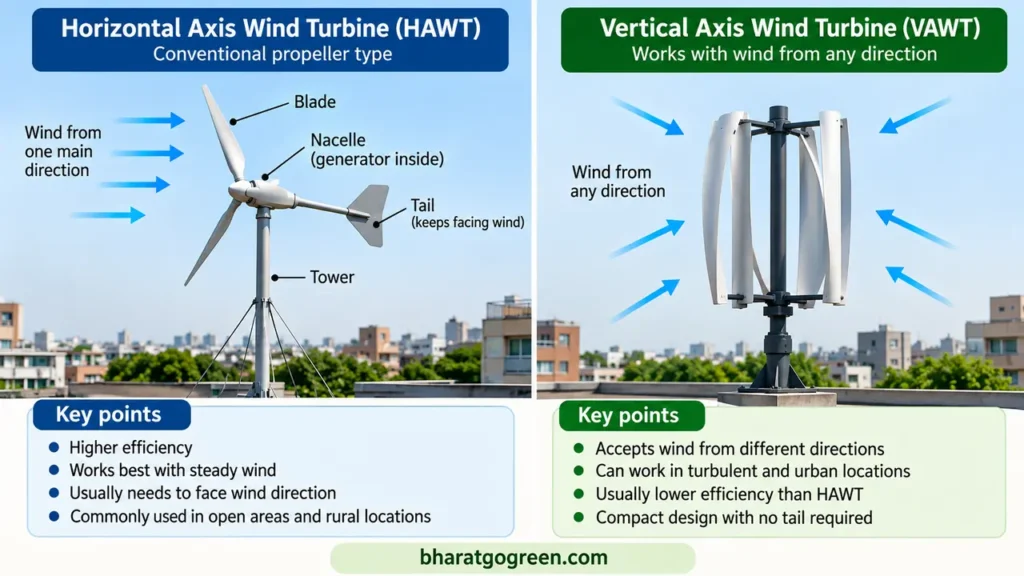
You will mainly come across two types of small wind turbines.
- VAWT : vertical axis wind turbine
- HAWT: horizontal axis wind turbine
A vertical axis wind turbine rotates around a vertical shaft. These turbines are now commonly promoted for terraces and urban buildings.
A horizontal axis wind turbine has a propeller type rotor similar to the large wind turbines we normally see in wind farms.
You may ask why vertical turbines are promoted so much for rooftops?
One reason is that they can accept wind coming from different directions without needing a yaw system to continuously face the wind.
That sounds useful in a city.
But there is one important point.
A turbine cannot create energy that is not present in the wind.
A vertical turbine may handle changing wind directions differently, but a highly turbulent roof can still have poor usable wind energy.
A horizontal turbine may work very well at an open location where the airflow is cleaner and the rotor is properly elevated.
So I would not choose a turbine simply because someone says VAWT is better for cities or HAWT is more efficient.
I would check the actual electrical power curve, rotor size, turbine height, site wind, noise, vibration, maintenance requirement and expected annual energy.
Does Indian Research Show Rooftop Wind Can Work?
Yes. There is recent Indian research on rooftop small wind turbines.
A 2025 study installed a small vertical axis wind turbine on a building in Sodepur, Kolkata.
The turbine was installed at about 21 m above ground, and the rooftop location was selected after measuring the wind with an anemometer. The researchers also studied vibration, airflow and electrical performance.
You can read the study here: 2025 Rooftop Vertical Axis Wind Turbine Study
But we need to understand what this study actually proves.
The electrical testing included controlled conditions using a fan and blower.
The reported electrical output during these tests ranged from about 0.05 W to 2.7 W as turbine speed increased.
So the study is useful because it shows that rooftop wind systems can be designed, installed and studied in an Indian urban environment.
But it does not prove that a commercial 1 kW turbine installed on any Indian terrace will generate high annual electricity.
There is a big difference between:
A turbine working
and
A turbine producing enough energy to justify its cost.
That is the difference a buyer should understand.
An Older Indian Study Gives an Important Warning
An older Indian study gives us another side of the story.
A 2013 IET study measured the actual output of two small wind turbines installed at urban locations in India.
The researchers then compared the measured generation with the expected generation calculated from manufacturer supplied power curves.
For the month of March, the first installation generated 40.4 kWh, while the estimated generation was 576.6 kWh.
At the second site, actual generation was only 18.55 kWh, compared with an estimated 727 kWh.
You can refer to the study here: Challenges to Diffusion of Small Wind Turbines in India
That is a very large difference.
The researchers pointed towards problems such as unreliable manufacturer power curves and the effect of obstacles and turbulence at urban sites.
Of course, this study is from 2013. Turbine design, electronics and testing have improved since then.
Still, the lesson is very relevant even today.
Do not buy a wind turbine only by looking at its rated capacity or brochure generation.
The real question is how much electricity it can produce at your site, under your wind conditions, over the full year.
I have rewritten these three sections in the same question based, practical style seen throughout your writing sample, where you first raise the reader’s doubt and then explain it in simple words. New Microsoft Word Document I have also rechecked the technical claims and the current 2026 price data.
What Should You Ask for in a Wind Turbine Power Curve?
Suppose a seller shows you a small wind turbine rotating even in light wind.
It looks impressive. But does this mean the turbine is producing enough electricity?
Not necessarily.
This is where the power curve becomes important.
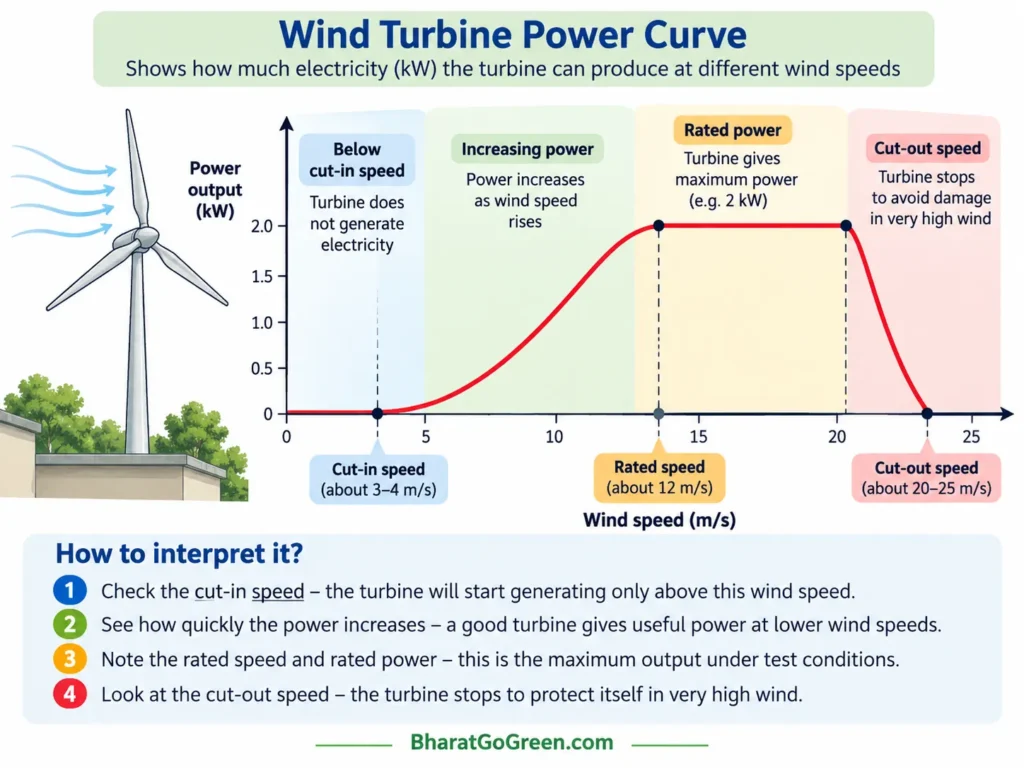
A power curve shows how much electrical power a wind turbine produces at different wind speeds.
For example, it may show the output at 4 m/s, 5 m/s, 8 m/s and so on until the turbine reaches its rated power.
NIWE includes power performance measurement among its wind turbine testing activities. It also carries out performance testing of small wind turbines.
The current IEC 61400 12 1:2022 standard also covers measurement of wind turbine power performance.
Importantly for us, it includes small wind turbines connected either to the electricity network or a battery bank.
So what should you ask the seller?
Ask for the power curve of the exact turbine model you are planning to buy.
Then check its rated wind speed.
If the seller says that the turbine gives good power even at 4 or 5 m/s, look at the curve and see how much electrical output is actually shown at these wind speeds.
There is one more question that I feel is equally important.
Who tested this power curve?
A power curve measured by an independent and competent testing laboratory gives us much more confidence than an unexplained graph printed in a sales brochure.
Check NIWE wind turbine testing activities
Check IEC 61400 12 1:2022
How Much Does a Home Wind Turbine Cost in India?
This question looks simple, but the answer can be confusing.
Why?
Because the price of the turbine and the price of the complete wind power system may not be the same.
For example, one Indian manufacturer currently lists a 1 kW horizontal wind turbine at ₹57,000 plus GST.
The same manufacturer lists a 2 kW vertical wind turbine at ₹2.20 lakh plus GST.
These are the manufacturer’s published prices as of 2026 and should not be considered an India wide market average.
Now suppose you find a 1 kW turbine for around ₹57,000.
Does it mean that you can install the complete system on your roof for the same amount?
Usually not.
You may also need a mast or tower, mounting structure, controller, wiring, earthing, electrical protection, lightning protection and an inverter.
If you want to store the electricity, a battery will also add to the cost.
The rooftop structure itself may need some work depending on the turbine size and mounting arrangement.
Installation cost can therefore become significant.
So before comparing two quotations, ask one very simple question.
What exactly is included in this price?
Also ask whether transport, installation, mounting structure, controller, inverter, battery and electrical protection are included.
Only after this can you compare the actual cost of two wind turbine systems.
Check the manufacturer’s 2026 wind turbine price page
Can a Home Wind Turbine Give Free Electricity at Night?
Yes, a wind turbine can generate electricity at night.
This is one advantage wind has over solar.
But does this mean that a wind turbine will give you electricity throughout the night?
The answer is no.
A wind turbine needs sufficient wind to produce useful power.
If good wind is available at night, it can continue generating electricity. But if the night is calm, its output may become very low or even zero.
This is an important point because sometimes we hear that wind power is available for twenty four hours.
Wind can generate at any time of the day. But it does not mean that it will generate continuously for twenty four hours.
What if you add a battery?
A battery can store the electricity generated earlier and supply it when required.
But remember, the battery does not produce any extra wind energy. It can only store what the turbine or another source has already generated.
Now think about combining wind with rooftop solar.
Solar normally produces most of its electricity during the daytime. Wind may sometimes continue during evening, night or periods when solar generation is lower.
So a solar and wind hybrid system sounds quite useful.
But will it always be better?
Not necessarily.
The wind at your home must actually be strong enough during those hours or seasons to justify the additional turbine, structure, controller and maintenance cost.
In simple words, solar and wind can complement each other, but only when the wind at your actual location supports it.
Can I Connect a Home Wind Turbine to the Grid or My Existing Solar System?
Suppose you already have rooftop solar at home. Now you want to add a small wind turbine.
Can you simply connect it to the same solar inverter?
Not necessarily.
A solar panel and a wind turbine generate electricity in different ways.
The output from a small wind turbine may first pass through a rectifier and wind controller.
Depending on the system, it may also require a braking arrangement or dump load to safely handle excess energy when the battery is full or the electricity cannot be used.
So, do not connect a wind turbine directly to the solar input of your existing inverter unless the inverter manufacturer specifically allows it.
Some hybrid systems are designed to work with both solar and wind.
In such cases, the controller, inverter and battery must all be electrically compatible.
Battery voltage and charging limits are also important. A wind turbine cannot be added just because its rated capacity looks suitable.
What If I Want to Export Wind Power to the Grid?
This becomes a little more complicated.
In India, the Central Electricity Authority has technical standards for connecting distributed generation resources.
The original regulations were issued in 2013 and amended in 2019.
There is one more point.
Even if the technical system can export electricity, it does not automatically mean that your existing solar net meter will accept wind generation.
The applicable State Electricity Regulatory Commission rules and your DISCOM requirements also need to permit the arrangement.
So before buying the turbine, ask the installer a simple question:
“Please show me in writing how this turbine will connect to my existing system and under which DISCOM provision the electricity can be exported.”
This small question may save you a lot of trouble later.
What About Noise, Vibration and Rooftop Safety?
A solar panel quietly remains fixed on the roof but a wind turbine is different.
Its rotor keeps moving whenever sufficient wind is available.
What does this mean for your house?
The support has to handle much more than the weight of the turbine.
Wind direction and speed keep changing.
The turbine therefore produces changing mechanical forces and vibration.
These forces ultimately reach the supporting structure.
This is why I would not simply fix a tall turbine pole to a parapet because the wall looks strong.
The current IEC 61400 2 standard covers the safety and engineering integrity of small wind turbines.
It includes the turbine, support structure, foundation, electrical system, installation, operation and maintenance.
Lightning protection also needs attention. The current consolidated IEC 61400 24 includes the 2024 amendment and covers lightning risk, blades, structural parts, electrical systems and earthing.
Do you live close to the sea?
Then corrosion becomes another practical issue.
If the turbine is installed on a high roof, you also need to think about maintenance access, very high winds and how the turbine will safely slow down or stop when required.
If you live in an apartment or shared building, roof ownership and society approval need to be checked before going too far with the technical work.
Why Site Matters More Than Turbine Size
Let us take a very simple example.
Two people buy exactly the same 2 kW wind turbine.
The first person lives on an open farmhouse. There are no tall buildings nearby.
The turbine is installed well above the surrounding obstacles and receives reasonably good wind.
The second person puts the same turbine on a city terrace. There is a water tank on one side and a taller neighboring building on the other.
Both turbines say 2 kW on the nameplate.
Both may also be rotating when you look at them.
But do you think both will generate the same electricity during the year?
The answer is no.
Buildings, trees, parapets and water tanks disturb the natural flow of wind. This creates turbulence.
The current DOE guidance also warns that rooftop turbines can face more turbulent wind, higher vibration and lower energy production than turbines placed in cleaner airflow.
I look at it in the same way we look at equipment in an industrial plant.
A nameplate tells us what the equipment is capable of under specified conditions. It does not tell us what it will actually deliver every day.
For a wind turbine, one of the most important operating conditions is very simple.
What wind is actually reaching the rotor throughout the year?
Before You Pay a Wind Turbine Vendor, Check These 10 Things
| No. | Check | What to ask |
| 1 | Site wind | What wind data was used and at what height? |
| 2 | Power curve | Show the exact model electrical power curve. |
| 3 | Rated wind speed | At what wind speed does the turbine actually reach rated output? |
| 4 | Annual generation | What assumptions were used for the promised units per year? |
| 5 | Testing | Was the model independently tested by NIWE or another competent accredited laboratory? |
| 6 | Complete price | Does the quote include mast, structure, controller, inverter, battery, protection, cables and installation? |
| 7 | Structure | Who confirms that the roof and mounting can handle dynamic loads? |
| 8 | Grid route | Which DISCOM or state rule allows the proposed connection? |
| 9 | Maintenance | Who services the turbine and what parts need regular inspection? |
| 10 | Subsidy evidence | What is the exact current government notification if a subsidy is being promised? |
If a seller can answer these questions with documents and measurements, you have something useful to evaluate.
If the main proof is only that the turbine starts spinning in low wind, you still do not know how much electricity it will produce.
Engineer’s View: What I Would Check First
Being from an engineering background, I would not begin with the turbine brochure.
I would begin with the site.
First, I would check whether the wind available at the location is good enough to deserve further investigation.
Then I would look at the exact position of the turbine. Are there nearby buildings, water tanks, parapet walls or trees disturbing the wind?
Why does this matter?
Because the wind shown in a weather app is not necessarily the same wind that reaches the turbine on your roof.
Buildings and other obstacles can make the airflow slow and turbulent.
This can reduce the actual energy produced by a small wind turbine.
Current small wind guidance also recommends judging a system by its expected annual energy output, using the actual site wind conditions and the turbine power curve.
After checking the site, I would ask for a tested power curve.
Only then would I compare whether a 1 kW, 2 kW or any other size makes sense.
This is the same basic logic we use with equipment in industry. Rated capacity is one number. Actual performance depends on operating conditions.
With rooftop wind, the operating condition is the clean and useful wind reaching the rotor over the year.
That is the number I would try to understand before spending money.
NIWE also confirms that small rooftop wind systems for homes do exist in India, including systems used for battery charging and grid connection.
So, Should You Install a Wind Turbine at Home?
The answer can be yes, but only at the right location.
If your home is in a genuinely windy and exposed area, a small wind turbine may be worth investigating.
A farmhouse, open coastal site, ridge, tall clear structure or remote property can offer much better conditions than a crowded city roof.
But do not buy a turbine only because a video shows that it starts rotating at a very low wind speed.
Also, do not assume that a turbine with a 1 kW label will keep producing 1 kW.
Ask one simple question first.
How many units can this turbine realistically generate at my site in one year?
That answer should come from the wind conditions at your location and the tested power curve of the turbine.
Annual energy is far more useful than the rated capacity written on the brochure.
Then check the structure, electrical arrangement, maintenance requirement, local rules and the total installed cost.
What if the wind resource is weak?
In that case, adding more rooftop solar or reducing your electricity consumption may give a much clearer return.
Small wind definitely has a place in India. The important part is not simply buying a turbine.
The important part is finding the right place for it.
Frequently Asked Questions
Can a 1 kW Wind Turbine Run a Home?
Yes, it can supply part of your home electricity, but a 1 kW turbine does not produce 1 kW all the time.
Its actual output keeps changing with wind speed, so the battery, inverter, grid supply and your home load also matter.
How Many Units Can a 1 kW Wind Turbine Generate in a Day?
There is no fixed answer for every home. The same 1 kW turbine may give very different daily generation at two locations because wind speed and wind conditions are different.
So, instead of asking only for units per day, ask the vendor for expected annual generation at your actual site.
What Wind Speed Do I Need for a Home Wind Turbine?
There is no single wind speed that makes a home wind turbine successful. A turbine may start rotating at a low wind speed but produce very little electricity there.
What matters more is how much usable wind is available at the turbine height during the year.
Is a VAWT Better Than a HAWT for a Rooftop?
Not always. A VAWT can take wind coming from different directions, which may look useful on a rooftop.
However, if the wind is weak or highly disturbed by nearby buildings, even a VAWT may not generate enough electricity.
Can I Connect a Wind Turbine to My Hybrid Solar Inverter?
Only if your inverter and the complete system are designed to accept wind power. Do not connect a wind turbine to the solar input just because the voltage looks similar. Check the inverter manual and approved connection arrangement first.
Is There a Central Subsidy for a Home Wind Turbine in India?
As of October 2026, there is no current central subsidy scheme for installing a home wind turbine similar to PM Surya Ghar. A recent Government reply also states that there is no financial subsidy or incentive scheme for onshore wind power projects. State level support may differ, so always check the latest local policy before buying.
Can a Wind Turbine Run an Air Conditioner?
Yes, but only when the complete system can supply the required power. A 2 kW turbine does not continuously give 2 kW, so the grid or battery may still be required when wind output falls.
Do I Need Permission to Put a Wind Turbine on My Roof?
It depends on your location, building type and how the turbine will be connected. A grid connected system may require DISCOM approval, while an apartment or shared building may also need society approval and a structural safety check. Always confirm the local requirements before installation.
References
- National Institute of Wind Energy. Small Wind Turbine Testing and Wind Energy Research Activities. Ministry of New and Renewable Energy, Government of India. Chennai, India. Accessed October 2026.
- National Institute of Wind Energy. Testing Services for Wind Turbines and Small Wind Turbine Systems. Ministry of New and Renewable Energy, Government of India. Chennai, India. Accessed October 2026.
- National Institute of Wind Energy. Wind Resource Map of India at 20 Metres Above Ground Level. Ministry of New and Renewable Energy, Government of India. Chennai, India. Accessed October 2026.
- Ministry of New and Renewable Energy. Wind Schemes and Guidelines. Government of India, New Delhi. Updated through July 2026. Accessed October 2026
- Ministry of New and Renewable Energy. Solar and Wind Power Plants in Rural Areas. Lok Sabha Unstarred Question No. 6114, answered 1 April 2026. Government of India, New Delhi.
- Central Electricity Authority. Central Electricity Authority Technical Standards for Connectivity of the Distributed Generation Resources Regulations, 2013, along with the Amendment Regulations, 2019. Ministry of Power, Government of India, New Delhi.
- Central Electricity Authority. Draft Central Electricity Authority Technical Standards for Connectivity to the Grid Regulations, 2026. Draft issued for public comments on 4 August 2026. Ministry of Power, Government of India, New Delhi.
- Government of Gujarat, Energy and Petrochemicals Department. Gujarat Integrated Renewable Energy Policy 2025. G.R. No. EPCD/REN/e-file/20/2025/1966/B1. Sachivalaya, Gandhinagar, 24 December 2025.
- Gujarat Energy Development Agency. Standard Operating Procedure for Small Scale Rooftop Wind Turbine Projects. Government of Gujarat, Gandhinagar. Accessed October 2026.
- International Electrotechnical Commission. IEC 61400-2:2013, Wind Turbines, Part 2: Small Wind Turbines. 3rd ed. Geneva: International Electrotechnical Commission, 2013.
- International Electrotechnical Commission. IEC 61400-12-1:2022, Wind Energy Generation Systems, Part 12-1: Power Performance Measurements of Electricity Producing Wind Turbines. 3rd ed. Geneva: International Electrotechnical Commission, 2022.
- International Electrotechnical Commission. IEC 61400-24:2019+AMD1:2024, Wind Energy Generation Systems, Part 24: Lightning Protection. Consolidated Version, Edition 2.1. Geneva: International Electrotechnical Commission, 2024.
- Basack, S., Podder, S., Dutta, S., and Lucchi, E. “Performance Analysis and Numerical Modeling of Mechanical and Electrical Components in a Rooftop Vertical-Axis Wind Turbine.” Energies, Vol. 18, No. 7, Article 1623, 2025. doi:10.3390/en18071623.
- Roy, A., Rathod, A., and Kulkarni, G. N. “Challenges to Diffusion of Small Wind Turbines in India.” Proceedings of the 2nd IET Renewable Power Generation Conference, RPG 2013, Beijing, China, 9 to 11 September 2013. Institution of Engineering and Technology. doi:10.1049/cp.2013.1840.
- Solario Editorial Team. “Wind Turbine Price in India 2026: Complete Price List, 1 kW to 3 kW.” Solario Technologies, 29 July 2026. Commercial market and price reference only.
- Chipmunk_Extra. “Can a Wind Turbine Realistically Power a Home in Delhi?” Reddit, r/delhi, 2026. Community discussion used only to identify homeowner questions and concerns, not as a technical source.